Worked solution
Treat the buildings as fixed labelled objects
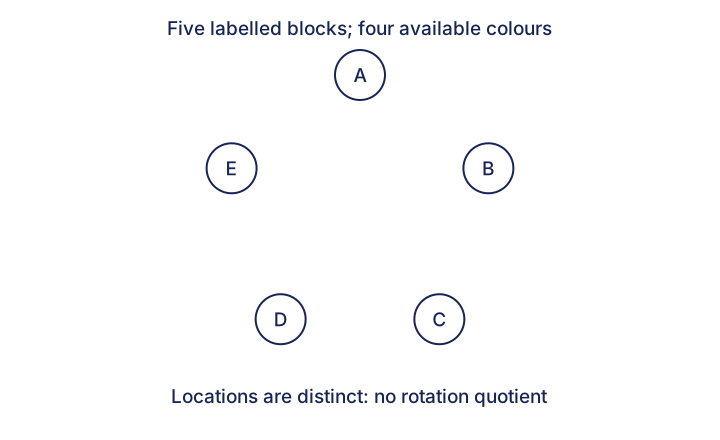
A developer has recently completed a condominium project in HCI Valley. There are 5 blocks of buildings A, B, C, D and E as shown. The developer has 4 colours available. Each block can only be painted using a single colour. Find the number of ways to paint all 5 blocks if
(i) there are no restrictions, mark
(ii) block A and block B cannot be painted with the same colour, marks
(iii) all 4 colours must be used. marks
Expand diagramFit diagram to page
Use the scrollbars or arrow keys to inspect details.
[2011/HCI/II/6]
CJC · Review problems · Question 8
Answer
(i) 1024; (ii) 768; (iii) 240.
(i) Independent colours
Each labelled building has 4 choices: .
(ii) Method 1: restrict B after choosing A
In A,B,C,D,E order, the numbers of choices are 4,3,4,4,4. Their product is .
(ii) Method 2: subtract equal A,B colours
Choose their shared colour in 4 ways and the remaining three building colours in ways. Hence .
(iii) Method 1: choose the repeated-colour pair
Using all four colours on five buildings forces multiplicities 2,1,1,1. Choose the two buildings sharing a colour, then assign the four distinct colours to the pair and three singleton buildings: .
(iii) Method 2: choose the repeated colour first
Choose which of the four colours repeats and permute the resulting multiset of five colour entries over the buildings: . Part (iii) is a separate condition and does not inherit the A/B restriction from (ii).
Common mistakes
The pentagonal placement does not make colourings equivalent under rotation: A–E are fixed labelled blocks.
Solution notes
Source building layout independently reconstructed with all labels. Both printed methods in(ii) and (iii) and every source factor/mark retained.