Worked solution
Explain every complement and the meaning of neighbouring ride seats
Three families comprising six adults and three children go on an outing to a theme park and travel together for the day.
(i) There are 15 amusement rides. A child insists on trying at least 2 of them. Calculate the number of ways this can be done. marks
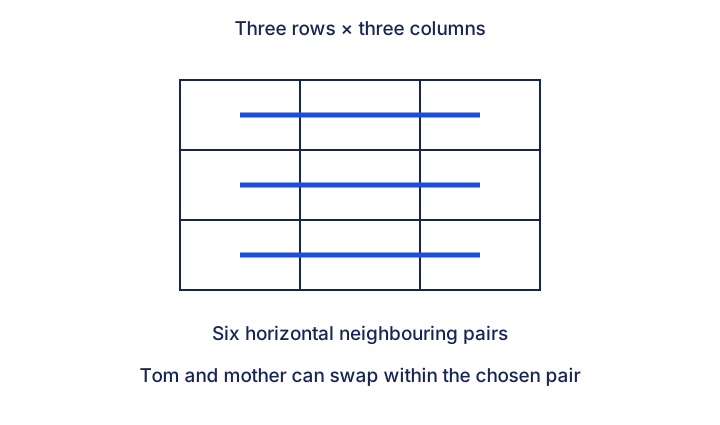
(ii) On the Mummy Surprise rollercoaster, a passenger car has seats in 3 rows and 3 columns as shown.
(a) Calculate the number of ways the families can be seated without restrictions. mark
(b) Tom, the youngest child, insists on sitting next to his mother. Calculate the number of ways this can be done. marks
(iii) At lunch they are allocated a circular table with 9 seats. Calculate the seating arrangements if none of the children sit together. marks
[2011/RJC/II/5]
CJC · Review problems · Question 14
Answer
(i) 32752; (ii)(a) 362880; (b) 60480; (iii) 14400.
(i) Method 1: exclude zero or one chosen ride
The source counts subsets of distinct rides, not their visiting order or repeat rides. Thus .
(i) Method 2: sum by subset size
.
(ii)(a) Method 1: nine fixed seats
The nine people are distinct and the nine seat positions are distinct: .
(ii)(a) Method 2: choose each row, then order within it
Choose three people for the first row, three from the remaining six for the second and the final three for the last. Each row has orders. Thus .
(ii)(b) Method 1: choose a side-by-side pair
The printed count uses horizontal neighbours within a row: two pairs per row, six pairs altogether. Choose one pair in ways, order Tom/mother in ways, then arrange the remaining seven people in ways. Hence . Vertical or diagonal proximity is not counted as “next to” in this seating model.
(ii)(b) Method 2: retain the row-by-row count
After choosing the pair and its two orders, choose the third person in that row from 7. Choose three of the remaining 6 for one other row, leaving three for the final row, and order each other row in ways. Thus .
(iii) Method 1: separate children using adult gaps
Arrange the six adults circularly in ways. Their six gaps receive three distinct children in ways. Thus .
(iii) Method 2: subtract disjoint adjacency patterns
Start with . All three children together contribute . For exactly one adjacent pair, arrange six adults circularly in ways; choose and order the child pair in ways; choose two different adult gaps for that pair and the singleton, and assign them in ways. This gives 21600. Hence .
Compare your sketch
Expand diagramFit diagram to page
Use the scrollbars or arrow keys to inspect details.
Common mistakes
“Next to” on the ride is horizontal side-by-side seating in the source model. For circular children, subtracting only the all-three-together case would miss adjacent pairs.
Solution notes
All eight source method stages, complete complement factors, blank 3×3 source grid and printed marks retained. Blue horizontal pair guides are explicitly explanatory additions. Ride-selection and horizontal-neighbour interpretations are stated.