Worked solution
Use the preceding meal to choose each transition probability
Mr Ong chooses either a Beef Combo Meal or a Chicken Combo Meal at a fast food restaurant. On his first visit, the probability of beef is 0.8. Thereafter, the probability of beef is 0.6 if he chose beef on the previous visit and 0.7 otherwise.
(i) Show that the probability of beef on each of the first three consecutive visits is 0.288. mark
(ii) Find the probability of exactly one beef meal in those visits. marks
(iii) Given exactly two chicken meals in those visits, find the probability that the second visit’s meal was beef. marks
[2014/VJC/II/6]
CJC · Review problems · Question 8
Answer
(i) 0.288; (ii) 0.194; (iii) .
Retain the complete source transition tree
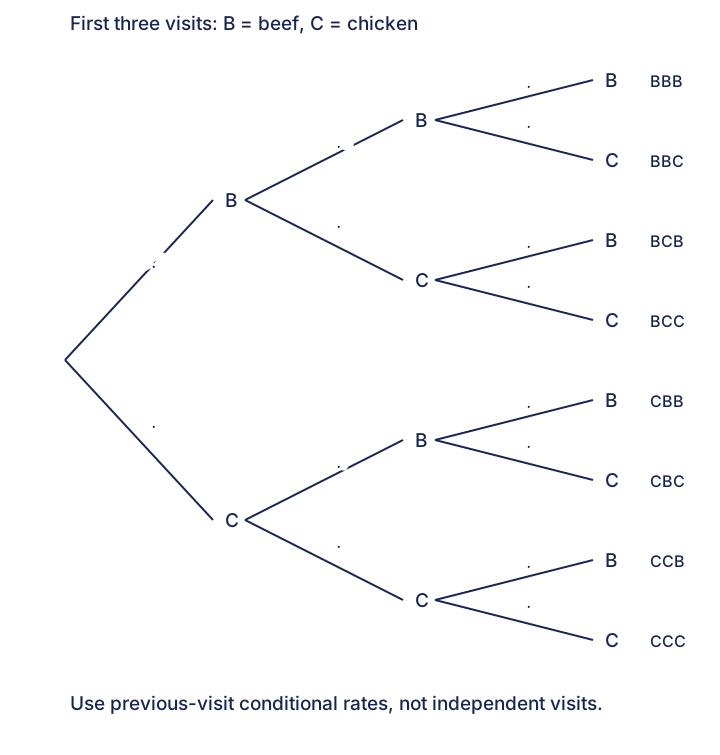
Let B mean beef and C chicken. The initial branches are 0.8/0.2. After B, next-B/next-C probabilities are 0.6/0.4; after C, they are 0.7/0.3. Apply the source’s previous-visit transition model at every later branch. All eight three-visit paths are shown in the reconstruction.
(i) Three beef meals
.
(ii) Exactly one beef meal
The disjoint paths are BCC, CBC, CCB. Their total is .
(iii) Reduce to the CBC path
Exactly two chicken meals means exactly one beef meal. Beef on visit 2 then requires CBC. Thus , retaining the source decimal.
Compare your sketch
Expand diagramFit diagram to page
Use the scrollbars or arrow keys to inspect details.
Common mistakes
Do not use one fixed beef probability independently on all three visits.
Solution notes
All three asks, all fourteen branch probabilities/eight source paths, every path product, conditional quotient, source decimal and marks retained. Exact 28/97 supplements the printed 0.289.