Worked solution
Give proper fractions and condition on both people finding jobs
Express all answers as proper fractions. In 2013,60% of the unemployed citizens of country A were graduates. Within a year,70% of these unemployed graduates found a job, while 40% of the unemployed non-graduates found one.
(i) A person unemployed in 2013 is chosen at random. Find the probability the person is not a graduate, given no job has been found. marks
(ii) Two people unemployed in 2013 are chosen at random. Find the probability that
(a) exactly one found a job within a year, marks
(b) exactly one is a graduate, given both found jobs within a year. marks
[2014/ACJC/II/10]
CJC · Review problems · Question 13
Answer
(i) ; (ii)(a) ; (b) .
(i) Read the full source tree
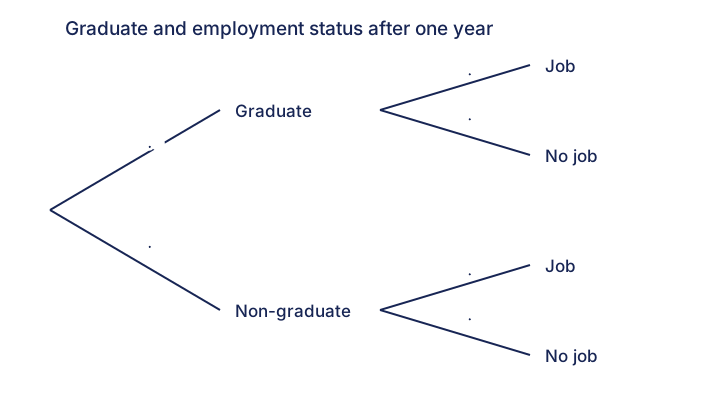
The graduate/non-graduate branches are 0.6/0.4. Job/no-job rates are 0.7/0.3 for graduates and 0.4/0.6 for non-graduates. Hence .
(ii)(a) Add the two ordered possibilities
, so . Under the source’s independent-person selection model, the probability of exactly one employed person is .
(ii)(b) Joint numerator and both-employed denominator
The favourable ordered pair is an employed graduate and an employed non-graduate, in either order. Thus
All final answers are proper fractions as requested. These two-person products use the source’s independence model; a specified finite population sampled without replacement would need its counts for an exact correction.
Compare your sketch
Expand diagramFit diagram to page
Use the scrollbars or arrow keys to inspect details.
Common mistakes
Do not use the original 60% graduate rate inside the employed-only population without conditioning.
Solution notes
Source proper-fraction instruction, all three asks, complete tree, exact intermediate marginals, ordered-pair products and marks retained. Independent-person model underlying source products is explicit.