Worked solution
Distinguish finite sampling from independent-person conditioning
(a) Mrs Wang bakes 15 chocolate and 25 blueberry cupcakes, then gives away 8 chosen at random. Find the probability exactly 3 are chocolate. marks
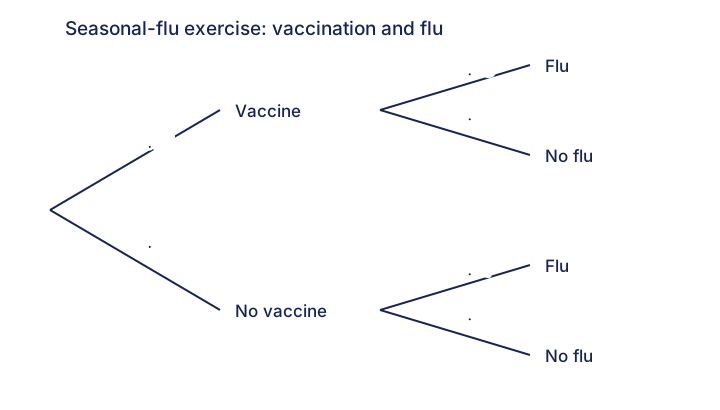
(b) In a seasonal-flu exercise, the probability a person receives a flu vaccine is 0.85. The probability of flu is 0.23 given vaccination and 0.91 given no vaccination. Find the probability that
(i) a person gets flu, marks
(ii) of two randomly chosen people who got flu, exactly one received the vaccine. marks
[2014/NJC/II/9]
CJC · Review problems · Question 14
Answer
(a) 0.314; (b)(i) ; (ii) 0.484 (rounded values 3 s.f.).
(a) Source method 1: unordered selections
Choose three chocolate and five blueberry cupcakes from the finite inventory, without replacement: (3 s.f.).
(a) Source method 2: one order, then its colour arrangements
For the order CCCBBBBB, multiply the changing counts, then multiply by the colour orders:
(b)(i) Total probability on the source tree
Vaccinated/unvaccinated probabilities are 0.85/0.15. The flu/no-flu branches are 0.23/0.77 and 0.91/0.09; the no-flu complements fill the unlabelled source branches. Hence .
(b)(ii) Condition both people on flu
Using the source’s independent-person model, exactly one vaccinated flu case can occur in two orders. Therefore
The denominator restricts both people to the flu population; it is not the unconditional vaccination probability.
Compare your sketch
Expand diagramFit diagram to page
Use the scrollbars or arrow keys to inspect details.
Common mistakes
Exactly one vaccinated among two flu cases is a conditional question;0.85 is not the vaccinated proportion among flu cases.
Solution notes
All source asks, both cupcake methods with every sequential factor, full tree relationships, total-probability fraction/decimal and two-person quotient retained. Unlabelled tree complements 0.77/0.09 are explicitly completed. Source person-independence model is stated.