Worked solution
Correct the intermediate expansion before solving for the percentage
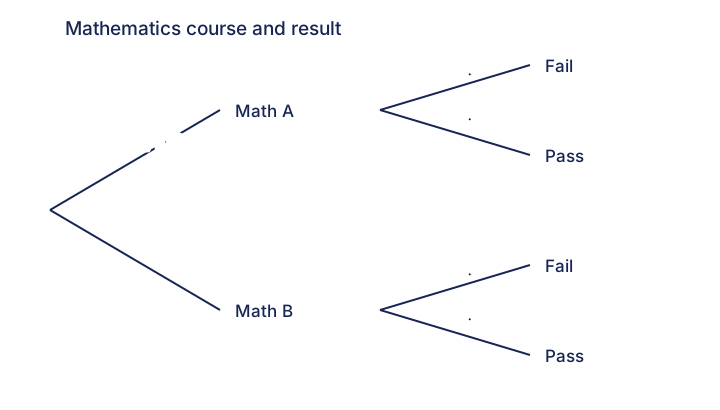
p% of students take Mathematics A and the remaining(100−p)% take Mathematics B.30% of Math A students fail and 40% of Math B students fail.
(i) Show that the probability exactly one of two students fails is . marks
(ii) Given the probability both take Math A, conditional on exactly one failing, is , find p. marks
[2014/RI/II/9]
CJC · Review problems · Question 15
Answer
(i) , with the source’s intermediate sign typo corrected; (ii) .
(i) Read both course/result branches
Let A,B denote the course and F failure. The course probabilities are and ; fail/pass probabilities are 0.3/0.7 and 0.4/0.6. Hence , and .
(i) Count the two independent-person orders
Using the source’s independent-student model, exactly one failure has probability
The source’s intermediate line prints ; those signs are reversed. The corrected expansion above yields the source’s intended final expression.
(ii) Form the joint event in the conditional numerator
Both take Math A with exactly one failure means one Math-A failure and one Math-A pass, in two orders. Thus
or .
(ii) Solve and reject the inadmissible percentage
Cross-multiplication gives , hence . The roots are and . Since p is a percentage in[0,100], reject the negative root and retain 40.
Compare your sketch
Expand diagramFit diagram to page
Use the scrollbars or arrow keys to inspect details.
Common mistakes
The source’s printed intermediate cross terms have reversed signs. Keep p as a percentage and reject the negative root.
Solution notes
Both asks, complete source tree, all marginal/conditional steps, quadratic stages, both roots/rejection and marks retained. Printed −4 p+6 p typo corrected +4 p−6 p explicitly while original native text remains verbatim. Independent-student model used in source products is stated.