Worked solution
Infer a normal standard deviation from symmetric tail areas
A Kranji farm sells chickens and ducks.
(a) Chicken mass has mean 2.5 kg and standard deviation 0.4 kg. If the probability that the mean of a large sample of chickens exceeds 2.45 kg is greater than 0.95, find the least . marks
(b) Duck mass kg is normal with mean 2.7 and standard deviation . Ducks cost $4 per kg. (i) Given , show that to 3s.f. marks (ii) A housewife brings $ 50. Find the probability she has less than $27.50 after buying2 ducks. marks (iii) For 4 randomly chosen ducks, find the probability the most expensive costs less than $ 11. marks
[2010/RVHS/II/13]
CJC · Review problems · Question 7
Answer
(a) . (b)(i) kg; (ii) ; (iii) .
(a) Minimum chicken sample size
By the CLT, for a large independent sample. Require , so . Thus and the least integer is 174.
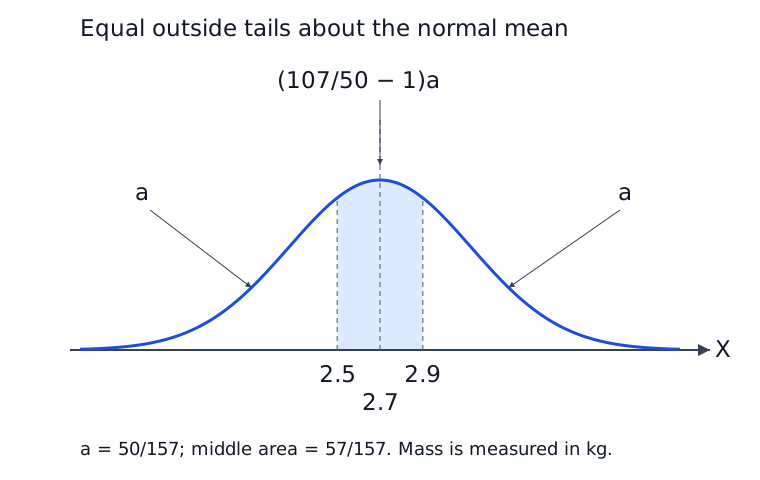
(b)(i) Use symmetry and the source area diagram
Let . The cutoffs 2.5 and 2.9 are equally spaced from the mean 2.7, so the right tail also has area , while . The middle area is . Hence , giving . Thus , so kg.
(b)(ii) Cost of two ducks
Using the printed rounded , one duck’s cost is . For independent ducks, . Having less than $27.50 left means spending more than $ 22.50, so the probability is .
(b)(iii) All four costs below the bound
The maximum cost is below 11 exactly when every duck costs below 11. Independence gives . Carrying the unrounded gives about 0.0895024, which has the same printed 3 s.f. value.
Compare your sketch
Expand diagramFit diagram to page
Use the scrollbars or arrow keys to inspect details.
Common mistakes
“Most expensive below 11” means all four are below 11. Use independent draws, and square monetary scale factors in variances.
Solution notes
The source defines chicken mass “in g” despite the question’s kg parameters. Authored working retains kg consistently; the original line is unchanged in the native source.