Worked solution
Use an iteration to approximate the specified cubic root
The cubic has a root in .
(i) Find to 5 decimal places. mark
(ii) For , , use a calculator to determine the sequence’s behaviour. marks
(iii) Prove algebraically that, if the sequence converges to , its limit is the root of the given cubic. marks
[2008/CJC/I/5]
CJC · Review problems · Question 15
Answer
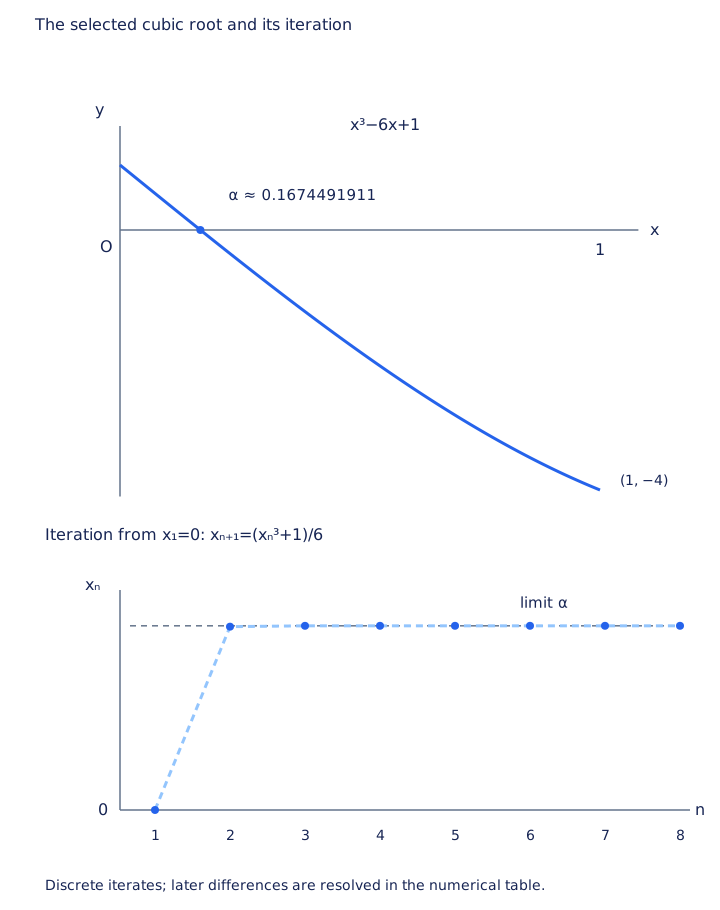
(5 d.p.); from the iteration increases to , and its limiting equation is .
(i) Select the root in the specified interval
The root in is , so to 5 d.p. Other roots of the cubic are not the root selected in this question.
(ii) Retain the calculator iteration behaviour
The source calculator iterates the recurrence from and reports increasing convergence to . The reproduced values are:
| n | x_n (approximately) |
|---|---|
| 1 | 0 |
| 2 | 0.16666666667 |
| 3 | 0.16743827160 |
| 4 | 0.16744903803 |
| 5 | 0.16744918896 |
| 6 | 0.16744919108 |
| 7 | 0.16744919111 |
| 8 | 0.16744919111 |
The first two nonzero exact values are , . Repeated rounded values are not a proof of exact equality or of convergence.
(iii) Pass to the limit in the continuous recurrence
If , then and . Hence , as required. For this starting value, increasing bounded convergence can also be checked: the map is increasing on , sends that interval into itself, and below . The conditional limit calculation alone is not a proof for arbitrary starting values.
Compare your sketch
Expand diagramFit diagram to page
Use the scrollbars or arrow keys to inspect details.
Common mistakes
A fixed-point calculation is conditional on convergence, and repeated calculator digits are not an exact constant sequence.