Porisma

Worked solution

Transfer a sign diagram to an absolute value

Without the use of a calculator, solve 6x−1<x\dfrac6{x-1}<x.

Hence, solve 6∣x∣−1<∣x∣\dfrac6{|x|-1}<|x|.

CJC · Review Problems · Question 1

Answer

−2<x<1-2<x<1 or x>3x>3; hence x<−3x<-3 or −1<x<1-1<x<1 or x>3x>3.

First inequality

Move x to the left and factor:

6x−1−x=−x2+x+6x−1=−(x−3)(x+2)x−1<0\dfrac6{x-1}-x=\dfrac{-x^2+x+6}{x-1}=-\dfrac{(x-3)(x+2)}{x-1}<0.

Equivalently, (x−3)(x+2)x−1>0\dfrac{(x-3)(x+2)}{x-1}>0. The critical values are −2, 1, 3 and successive interval signs are −,+,−,+.

Therefore −2<x<1-2<x<1 or x>3x>3.

How did this part go?

Hence inequality

Replace the input in the preceding result by ∣x∣|x|:

−2<∣x∣<1-2<|x|<1 or ∣x∣>3|x|>3.

Since ∣x∣≥0|x|\geq0, this becomes ∣x∣<1|x|<1 or ∣x∣>3|x|>3.

Therefore x<−3 or −1<x<1 or x>3\boxed{x<-3\text{ or }-1<x<1\text{ or }x>3}. The inputs x=±1x=\pm1 remain excluded by the denominator.

How did this part go?

Compare your sketch

Expand diagram

Use the scrollbars or arrow keys to inspect details.
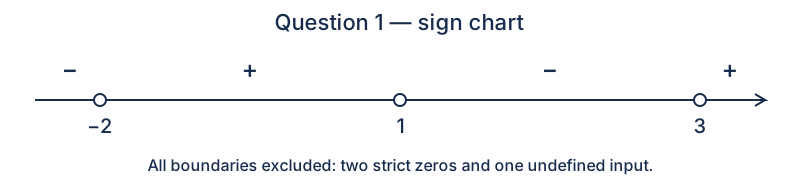
For (x−3)(x+2)/(x−1), signs are negative, positive, negative, positive across −2, 1 and 3. All three boundaries are open. The positive intervals are (−2,1) and (3, infinity).

Common mistakes

Multiplying directly by x−1 without checking its sign can reverse the inequality on the wrong intervals.

Solution notes

The source sign chart is independently reconstructed; use the labelled critical values, signs and open endpoints rather than illustrative spacing.

Read the hint