Porisma

Worked solution

Transfer a rational inequality to logarithmic inputs

(i) Without using a calculator, solve the inequality 5x−1x2+x−6≤1\dfrac{5x-1}{x^2+x-6}\leq1. marks

(ii) Hence solve the inequality 1+1−5ln⁡x(ln⁡x)2+ln⁡x−6≥01+\dfrac{1-5\ln x}{(\ln x)^2+\ln x-6}\geq0. marks

[2013/YJC/I/4]

CJC · Review Problems · Question 3

Answer

(i) (−∞,−3)∪[−1,2)∪[5,∞)(-\infty,-3)\cup[-1,2)\cup[5,\infty); (ii) (0,e−3)∪[e−1,e2)∪[e5,∞)(0,e^{-3})\cup[e^{-1},e^2)\cup[e^5,\infty).

(i)

Write 1−5x−1x2+x−6=x2−4x−5x2+x−6=(x+1)(x−5)(x+3)(x−2)≥01-\dfrac{5x-1}{x^2+x-6}=\dfrac{x^2-4x-5}{x^2+x-6}=\dfrac{(x+1)(x-5)}{(x+3)(x-2)}\geq0. The signs across −3,−1,2,5-3,-1,2,5 are +,−,+,−,++,-,+,-,+. Thus x<−3x<-3 or −1≤x<2-1\leq x<2 or x≥5x\geq5.

How did this part go?

(ii)

The displayed expression is 1−5ln⁡x−1(ln⁡x)2+ln⁡x−61-\dfrac{5\ln x-1}{(\ln x)^2+\ln x-6}. Set the input in (i) to ln⁡x\ln x, where x>0x>0. Then ln⁡x<−3\ln x<-3, or −1≤ln⁡x<2-1\leq\ln x<2, or ln⁡x≥5\ln x\geq5. Exponentiation preserves order, giving 0<x<e−30<x<e^{-3} or e−1≤x<e2e^{-1}\leq x<e^2 or x≥e5x\geq e^5.

How did this part go?

Compare your sketch

Expand diagram

Use the scrollbars or arrow keys to inspect details.
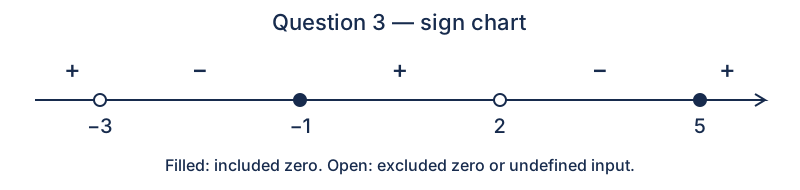
The nonnegative rational expression has successive signs positive, negative, positive, negative, positive across −3, −1, 2 and 5. Include −1 and 5; exclude the poles −3 and 2.

Common mistakes

The logarithm requires positive x; the original poles become x=e^(−3) and x=e².

Solution notes

The sign chart is independently drawn from the printed solution. Spacing is illustrative; labelled critical values and open/closed endpoints determine the set.

Read the hint