Worked solution
A repeated zero and an exponential deduction
Without the use of a calculator, solve the inequality . marks
Hence, solve . marks
[2013/DHS/I/2]
CJC · Review Problems · Question 4
Answer
Base: . Hence .
First inequality
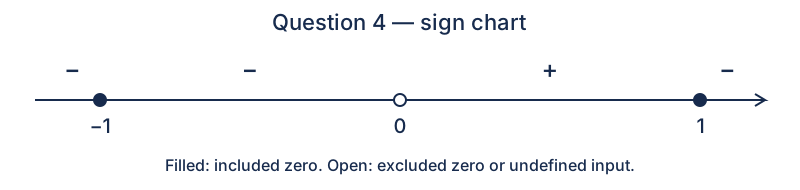
Move the right side to the left and factor: . The signs across are . The repeated numerator zero is included without a sign change. The pole 0 is excluded and the zero 1 is included. Thus or .
Hence
Let the original input be . Its left-minus-right expression is . The original result requires or . Reject because ; gives .
Compare your sketch
Expand diagramFit diagram to page
Use the scrollbars or arrow keys to inspect details.
Common mistakes
A repeated root can be included even when the sign does not change. The substituted exponential input cannot be negative.
Solution notes
The sign chart is independently drawn from the printed solution. Spacing is illustrative; labelled critical values and open/closed endpoints determine the set.