Worked solution
Use a positive numerator to simplify a cubic ratio
Without using a calculator, solve the inequality . marks
[2016/NYJC/Promo/2]
CJC · Review Problems · Question 5
Answer
.
Solution
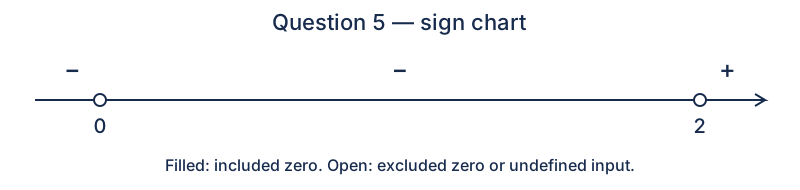
Subtract 1: . Since for all real , only the denominator controls the sign. Away from its poles, . The signs on are . There are no numerator zeros to include, and are undefined. Hence .
How did this part go?
Compare your sketch
Expand diagramFit diagram to page
Use the scrollbars or arrow keys to inspect details.
Common mistakes
A non-strict inequality need not include any boundary when every critical value is a pole.
Solution notes
The sign chart is independently drawn from the printed solution. Spacing is illustrative; labelled critical values and open/closed endpoints determine the set.