Worked solution
Prove positivity and retain an isolated equality
Given that is real, prove algebraically that is always positive. mark
Hence, without using a graphing calculator, find the range of values of that satisfy . marks
[2016/MJC/Promo/1]
CJC · Review Problems · Question 6
Answer
or .
Positivity
Complete the square: for every real . Alternatively, the discriminant is and the leading coefficient is positive, so the quadratic is positive everywhere.
Inequality
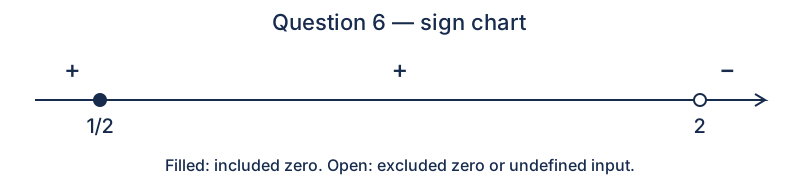
The difference is . Divide out the strictly positive quadratic and negate to get . This is positive on both sides of before the pole 2, zero at , and negative for . Thus or .
Compare your sketch
Expand diagramFit diagram to page
Use the scrollbars or arrow keys to inspect details.
Common mistakes
Dividing by the squared numerator would lose the isolated solution x=1/2.
Solution notes
The sign chart is independently drawn from the printed solution. Spacing is illustrative; labelled critical values and open/closed endpoints determine the set.