Worked solution
A positive quadratic with an absolute-value input
Without using a calculator, solve the inequality . marks
Hence solve . marks
[2016/YJC/Promo/10(b)]
CJC · Review Problems · Question 7
Answer
Base: or . Hence .
First inequality
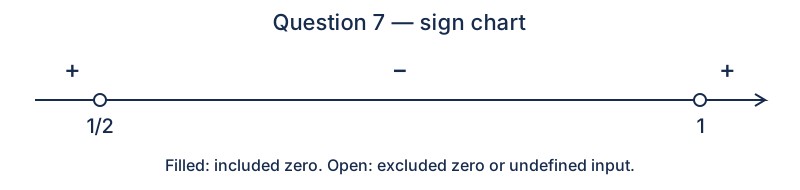
Add 1 to obtain . The numerator is positive for all real , so solve . The signs across are , with both poles excluded. Hence or .
How did this part go?
Hence
Since , replace the original input by . Then or , giving or or .
How did this part go?
Compare your sketch
Expand diagramFit diagram to page
Use the scrollbars or arrow keys to inspect details.
Common mistakes
The x² term remains correct under the replacement because x²=|x|².
Solution notes
The sign chart is independently drawn from the printed solution. Spacing is illustrative; labelled critical values and open/closed endpoints determine the set.