Worked solution
Use a nonpositive squared input
(a) Using an algebraic method, solve the inequality . marks
(b) Hence solve the inequality . marks
[2013/CJC/I/4]
CJC · Review Problems · Question 8
Answer
(a) or ; (b) or .
(a)
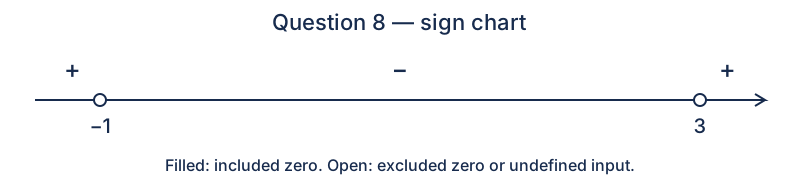
Subtract 1 to obtain . The numerator is always positive. Alternatively, its discriminant is and its leading coefficient is positive. Thus , with signs across the excluded poles . Hence or .
(b)
Replace the original input by : . The result in (a) gives or . The second branch is impossible because ; the first gives , hence or .
Compare your sketch
Expand diagramFit diagram to page
Use the scrollbars or arrow keys to inspect details.
Common mistakes
Use −x², rather than x², and simplify both numerator and denominator before transferring the solution.
Solution notes
The sign chart is independently drawn from the printed solution. Spacing is illustrative; labelled critical values and open/closed endpoints determine the set.