Worked solution
Compare squared and reflected inputs
Do not use a calculator in answering this question.
Solve the inequality . marks
Deduce the solution of
(i) , marks
(ii) . marks
[2016/RI/Promo/3]
CJC · Review Problems · Question 9
Answer
Base: or ; (i) or ; (ii) or .
Base inequality
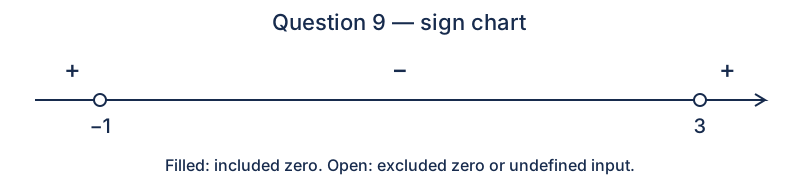
Subtract 1 to obtain . The numerator is always positive. Alternatively, its discriminant is and its leading coefficient is positive. Thus , with signs across the excluded poles . Hence or .
(i)
Replace the original input by . Then or . Since , reject the first branch. Thus or .
(ii)
Replace the original input by . The fraction becomes . Thus or , giving or .
Compare your sketch
Expand diagramFit diagram to page
Use the scrollbars or arrow keys to inspect details.
Common mistakes
Although the base inequality matches Q8, the printed paper and deductions are distinct; preserve this question identity.
Solution notes
The sign chart is independently drawn from the printed solution. Spacing is illustrative; labelled critical values and open/closed endpoints determine the set.