Porisma

Worked solution

Compare absolute-value graphs in two ways

Find the solution sets of the following inequalities.

(a) x2<∣x−2∣x^2<|x-2|,

(b) ∣x+13x−5∣>1\left|\dfrac{x+1}{3x-5}\right|>1.

CJC · Review Problems · Question 10

Answer

(a) (−2,1)(-2,1); (b) (1,5/3)∪(5/3,3)(1,5/3)\cup(5/3,3).

(a) Method 1: one graph

Sketch y=x2−∣x−2∣y=x^2-|x-2|. The graph crosses the axis at x=−2,1x=-2,1 and has the source-labelled minimum (−12,−94)(-\frac12,-\frac94). It lies below the axis exactly for −2<x<1-2<x<1.

How did this part go?

(a) Method 2: two graphs

Sketch y=x2y=x^2 and y=∣x−2∣y=|x-2| on the same axes. They intersect at (−2,4)(-2,4) and (1,1)(1,1); the absolute-value graph has vertex (2,0)(2,0). The parabola lies below the absolute-value graph between the intersections, so the set is {x∈R:−2<x<1}\{x\in\mathbb R:-2<x<1\}.

How did this part go?

(b) Method 1: one graph

Sketch y=∣x+13x−5∣−1y=\left|\dfrac{x+1}{3x-5}\right|-1. Its domain excludes x=53x=\frac53, its vertical asymptote is x=53x=\frac53, and its horizontal asymptote is y=−23y=-\frac23. It has minimum (−1,−1)(-1,-1) and zeros 1,31,3. It is positive between 1 and 3, with the pole removed: {x∈R:1<x<3, x≠53}\{x\in\mathbb R:1<x<3,\ x\ne\frac53\}.

How did this part go?

(b) Method 2: two graphs

Compare y=∣x+13x−5∣y=\left|\dfrac{x+1}{3x-5}\right| with y=1y=1. The ratio has minimum (−1,0)(-1,0), horizontal asymptote y=13y=\frac13 and vertical asymptote x=53x=\frac53. The intersections with y=1y=1 occur at x=1,3x=1,3; the ratio is larger on (1,53)∪(53,3)(1,\frac53)\cup(\frac53,3).

How did this part go?

Compare your sketch

Expand diagram

Use the scrollbars or arrow keys to inspect details.
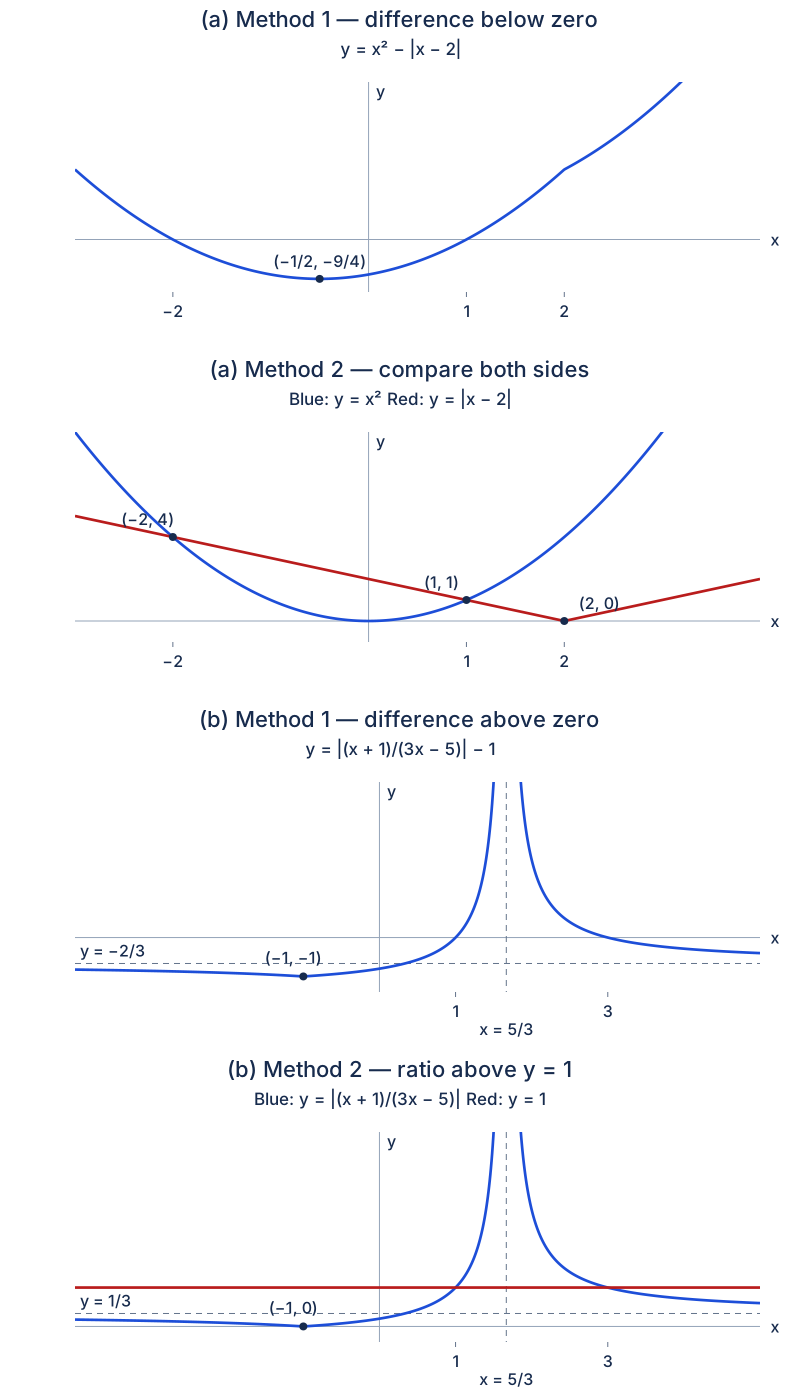
Four panels preserve both methods for each part. For (a), the difference has zeros −2 and 1 and minimum (−1/2,−9/4); the two graphs intersect at (−2,4) and (1,1), with the V vertex at (2,0). For (b), the difference has zeros 1 and 3, minimum (−1,−1), horizontal asymptote −2/3 and vertical asymptote 5/3. The unshifted ratio has minimum (−1,0), horizontal asymptote 1/3, the same pole and crossings with y=1 at 1 and 3.

Common mistakes

An interval bounded by two intersections can still contain a forbidden denominator input.

Solution notes

The diagrams are independently reconstructed mathematical equivalents. The plotted geometry is illustrative; use the labelled exact or approximate values and the stated domain.

The first printed graph for (b) appears to label its left zero as 2; the printed final set and second graph give 1. Solving |x+1|=|3x−5| gives 1 and 3, so the reconstruction labels 1. No marks are printed for Q10.

Read the hint