Porisma

Worked solution

Read an absolute-value comparison from two graph methods

Solve the inequality x+5<∣2x−1∣+∣x−3∣x+5<|2x-1|+|x-3|. marks

[2011/JJC/I/2]

CJC · Review Problems · Question 11

Answer

x<−14x<-\frac14 or x>92x>\frac92.

Method 1: one graph

Sketch y=(x+5)−∣2x−1∣−∣x−3∣y=(x+5)-|2x-1|-|x-3|. Its zeros are −14-\frac14 and 92\frac92. The graph is below the axis to the left of −14-\frac14 and to the right of 92\frac92, so x<−14x<-\frac14 or x>92x>\frac92.

How did this part go?

Method 2: two graphs

Sketch y=x+5y=x+5 and y=∣2x−1∣+∣x−3∣y=|2x-1|+|x-3|. They meet at inputs −14-\frac14 and 92\frac92. The straight line lies below the absolute-value sum outside those inputs. Hence the same strict solution set is (−∞,−14)∪(92,∞)(-\infty,-\frac14)\cup(\frac92,\infty).

How did this part go?

Compare your sketch

Expand diagram

Use the scrollbars or arrow keys to inspect details.
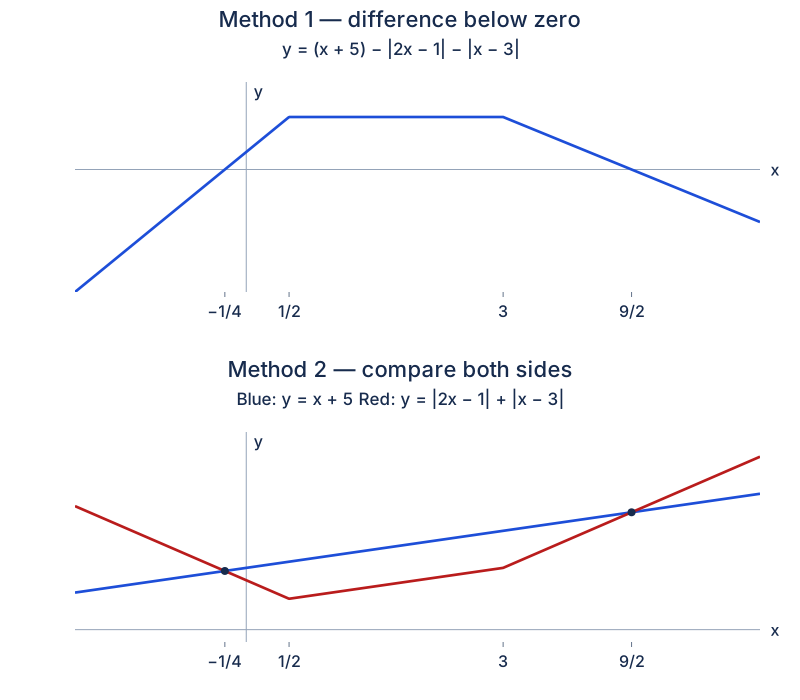
The first panel plots the difference: it is 4x+1 before 1/2, constant 3 from 1/2 to 3, and 9−2x after 3. It crosses zero at −1/4 and 9/2. The second panel compares x+5 with |2x−1|+|x−3| and marks both crossings; the line is lower outside them.

Common mistakes

There are no absolute-value bars around x+5 in the printed question.

Solution notes

The diagrams are independently reconstructed mathematical equivalents. The plotted geometry is illustrative; use the labelled exact or approximate values and the stated domain.

The source one-graph artwork has displaced labels and a small separate curve. The reconstruction plots the stated function continuously; the source equations, crossings and both printed conclusions are retained.

Read the hint