Porisma

Worked solution

Use one displacement for four vector tasks

The position vectors of A, B and C are a=i−j+2k\mathbf a=\mathbf i-\mathbf j+2\mathbf k, b=3i+5j−2k\mathbf b=3\mathbf i+5\mathbf j-2\mathbf k and c=pj+4k\mathbf c=p\mathbf j+4\mathbf k respectively.

(i) Find the unit vector in the direction of AB→\overrightarrow{AB}. marks

(ii) Find the value of p such that A, B and C are collinear. marks

(iii) If p=−1p=-1, find the position vector of D such that ABCD is a parallelogram. marks

(iv) If ∣AC→∣=3|\overrightarrow{AC}|=3, find the possible values of p. marks

CJC · Review problems · Question 1

Answer

(i)(1,3,−2)/√14; (ii)p=−4; (iii)OD=(−2,−7,8); (iv)p=−3 or 1.

(i) Normalise AB

AB=(3,5,−2)−(1,−1,2)=(2,6,−4)=2(1,3,−2)AB=(3,5,-2)-(1,-1,2)=(2,6,-4)=2(1,3,-2). Hence the unit vector is

(1,3,−2)14=1414(1,3,−2).\begin{aligned}&\frac{(1,3,-2)}{\sqrt{14}}\\ & =\frac{\sqrt{14}}{14}(1,3,-2).\end{aligned}

How did this part go?

(ii) Require consistent scalar multiples

AC=(−1,p+1,2)AC=(-1,p+1,2). Write AB=kACAB=kAC: 2=−k2=-k, 6=k(p+1)6=k(p+1), −4=2k-4=2k. The first and third give k=−2k=-2; the middle then gives p=−4p=-4.

How did this part go?

(iii) Complete the specified parallelogram

At p=−1p=-1, OC=(0,−1,4)OC=(0,-1,4). Since AB=DC=OC−ODAB=DC=OC-OD,

OD=OC−AB=(0,−1,4)−(2,6,−4)=(−2,−7,8).\begin{aligned}&OD\\ & =OC-AB\\ & =(0,-1,4)-(2,6,-4)\\ & =(-2,-7,8).\end{aligned}

The schematic preserves order A,B,C,D.

How did this part go?

(iv) Apply the magnitude condition

∣AC∣=1+(p+1)2+4=3.|AC|=\sqrt{1+(p+1)^2+4}=3.

Squaring gives p2+2p−3=0p^2+2p-3=0, so (p+3)(p−1)=0(p+3)(p-1)=0 and p=−3p=-3 or 11.

How did this part go?

Compare your sketch

Expand diagram

Use the scrollbars or arrow keys to inspect details.
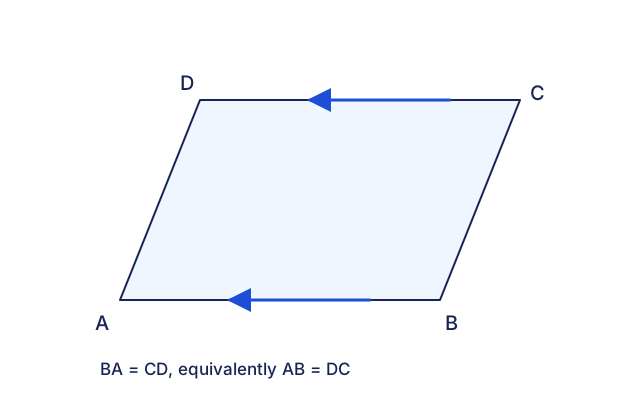
Planar schematic ABCD: A lower left, B lower right, C upper right,D upper left. Source arrows B→A,C→D express equal opposite-side vectors. Equivalently AB=DC, yielding OD=(-2,-7,8) for p=-1. Illustration is not a coordinate projection.

Common mistakes

The bars in part (iv) are essential: the vector is not equal to the scalar 3.

Solution notes

All four asks, rationalised unit-vector form and source parallelogram retained. Missing extraction radicals and magnitude bars restored against the images.

Read the hint