Porisma

Worked solution

Find a displacement and prove a line intersection ratio

Relatively to an origin O, the position vectors of A, B and P are a\mathbf a, b\mathbf b and 12(a+b)\frac12(\mathbf a+\mathbf b) respectively, where a and b are non-zero and non-parallel vectors. The point Q lies on the line segment OP such that OQ:QP=2:1. The line AQ cuts OB at R.

(i) Find, in terms of a and b, AQ→\overrightarrow{AQ}. marks

(ii) Show that OR→=12b\overrightarrow{OR}=\frac12\mathbf b. marks

[2012/MJC/Promo/2]

CJC · Review problems · Question 2

Answer

(i)AQ=(b−2a)/3; (ii)OR=b/2.

(i) Method 1: section formula based at A

Q divides OP in ratio 2:1. Relative to A,

AQ=AO+2AP3=−OA+2(OP−OA)3=2OP−3OA3=b−2a3.\begin{aligned}&AQ\\ & =\frac{AO+2AP}{3}\\ & =\frac{-OA+2(OP-OA)}3\\ & =\frac{2OP-3OA}3\\ & =\frac{\mathbf b-2\mathbf a}{3}.\end{aligned}

How did this part go?

(i) Method 2: subtract position vectors

OQ=23OP=13(a+b)OQ=\frac23OP=\frac13(\mathbf a+\mathbf b), so

AQ=OQ−OA=13(a+b)−a=b−2a3.\begin{aligned}&AQ\\ & =OQ-OA\\ & =\frac13(\mathbf a+\mathbf b)-\mathbf a\\ & =\frac{\mathbf b-2\mathbf a}{3}.\end{aligned}

How did this part go?

(ii) Method 1: compare two expressions for AR

Since O,R,B are collinear, write OR=λbOR=\lambda\mathbf b; since A,Q,R are collinear, AR=μAQAR=\mu AQ. Then

λb−a=μ3(b−2a).\lambda\mathbf b-\mathbf a=\frac\mu3(\mathbf b-2\mathbf a).

Rearranging gives (2μ/3−1)a=(μ/3−λ)b(2\mu/3-1)\mathbf a=(\mu/3-\lambda)\mathbf b. Independence of a,b requires 2μ/3−1=02\mu/3-1=0 and μ/3−λ=0\mu/3-\lambda=0. Thus μ=3/2\mu=3/2, λ=1/2\lambda=1/2, proving OR=b/2OR=\mathbf b/2.

How did this part go?

(ii) Method 2: compose OR through A

Alternatively

OR=OA+AR=a+μ3(b−2a)=λb.\begin{aligned}&OR\\ & =OA+AR\\ & =\mathbf a+\frac\mu3(\mathbf b-2\mathbf a)\\ & =\lambda\mathbf b.\end{aligned}

Equating coefficients gives λ−μ/3=0\lambda-\mu/3=0 and 1−2μ/3=01-2\mu/3=0, yielding the same μ=3/2\mu=3/2, λ=1/2\lambda=1/2 and OR=b/2OR=\mathbf b/2.

How did this part go?

Compare your sketch

Expand diagram

Use the scrollbars or arrow keys to inspect details.
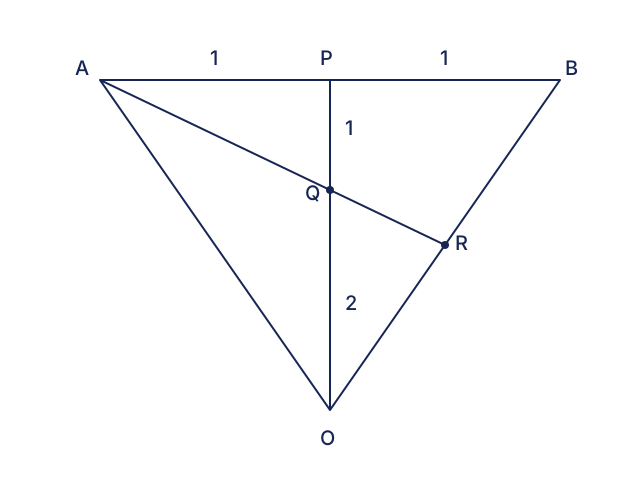
Triangle AOB with P the midpoint of AB. O,Q,P lie in order with OQ:QP=2:1. A,Q,R lie in order and R lies on OB. The diagram uses exact midpoint and two-to-one placement, giving R halfway from O to B. Source AP:PB labels 1:1 and OQ:QP labels 2:1 are retained.

Common mistakes

Equating independent coefficients is justified by the given nonzero, nonparallel vectors.

Solution notes

Both printed methods in each part retained. Source triangle with midpoint P and division Q is reconstructed with matching point order and ratios.

Read the hint