Porisma

Worked solution

Recover a dot product, projection and a parameterised area

Referred to the origin O, the points A and B have position vectors a and b respectively such that ∣a∣=5|\mathbf a|=5 and ∣b∣=3|\mathbf b|=3.

(i) It is given that ∣2b−a∣=7|2\mathbf b-\mathbf a|=7. Using a suitable scalar product, show that a⋅b=3\mathbf a\cdot\mathbf b=3. marks

(ii) Deduce the length of projection of OA→\overrightarrow{OA} onto OB→\overrightarrow{OB}. mark

The point P lies on AB such that AP:PB=1:k, where k is a positive constant.

(iii) Write down the position vector of P in terms of k,a and b and show that the area of triangle OAP is 36k+1\dfrac{3\sqrt6}{k+1}. marks

[2022/NYJC/Promo/5]

CJC · Review problems · Question 3

Answer

a·b=3; projection length 1; OP=(ka+b)/(k+1); area=3√6/(k+1).

(i) Square the magnitude using a dot product

∣2b−a∣2=(2b−a)⋅(2b−a)=4∣b∣2+∣a∣2−4a⋅b=49.\begin{aligned}&|2\mathbf b-\mathbf a|^2\\ & =(2\mathbf b-\mathbf a)\cdot(2\mathbf b-\mathbf a)\\ & =4|\mathbf b|^2+|\mathbf a|^2-4\mathbf a\cdot\mathbf b\\ & =49.\end{aligned}

Thus 4(32)+52−4a⋅b=494(3^2)+5^2-4\mathbf a\cdot\mathbf b=49, so 4a⋅b=124\mathbf a\cdot\mathbf b=12 and a⋅b=3\mathbf a\cdot\mathbf b=3.

How did this part go?

(ii) Project onto a unit direction

The nonnegative projection length is

∣a⋅b^∣=∣a⋅b∣∣b∣=33=1.|\mathbf a\cdot\widehat{\mathbf b}|=\frac{|\mathbf a\cdot\mathbf b|}{|\mathbf b|}=\frac33=1.

How did this part go?

(iii) Locate P and reduce the cross product

The section formula gives

OP=ka+bk+1.OP=\frac{k\mathbf a+\mathbf b}{k+1}.

Hence

area⁡(OAP)=12∣OP×OA∣=12(k+1)∣ka×a+b×a∣=∣a×b∣2(k+1).\begin{aligned}&\operatorname{area}(OAP)\\ & =\frac12|OP\times OA|\\ & =\frac1{2(k+1)}|k\mathbf a\times\mathbf a+\mathbf b\times\mathbf a|\\ & =\frac{|\mathbf a\times\mathbf b|}{2(k+1)}.\end{aligned}

Here a×a=0\mathbf a\times\mathbf a=\mathbf0 and reversing the cross product changes only its sign, not its magnitude.

How did this part go?

(iii) Evaluate the sine in two printed ways

Let θ be the angle between a,b. Then cos⁡θ=3/(5⋅3)=1/5\cos\theta=3/(5\cdot3)=1/5. A right triangle with hypotenuse 5 and adjacent side 1 has opposite side 25−1=26\sqrt{25-1}=2\sqrt6, so sin⁡θ=26/5\sin\theta=2\sqrt6/5. The source alternative is the identity sin⁡θ=1−cos⁡2θ=1−1/25=26/5\sin\theta=\sqrt{1-\cos^2\theta}=\sqrt{1-1/25}=2\sqrt6/5.

How did this part go?

(iii) Finish the area

area⁡(OAP)=(5)(3)(26/5)2(k+1)=36k+1.\begin{aligned}&\operatorname{area}(OAP)\\ & =\frac{(5)(3)(2\sqrt6/5)}{2(k+1)}\\ & =\frac{3\sqrt6}{k+1}.\end{aligned}

Positive k ensures the section is internal and k+1>0.

How did this part go?

Compare your sketch

Expand diagram

Use the scrollbars or arrow keys to inspect details.
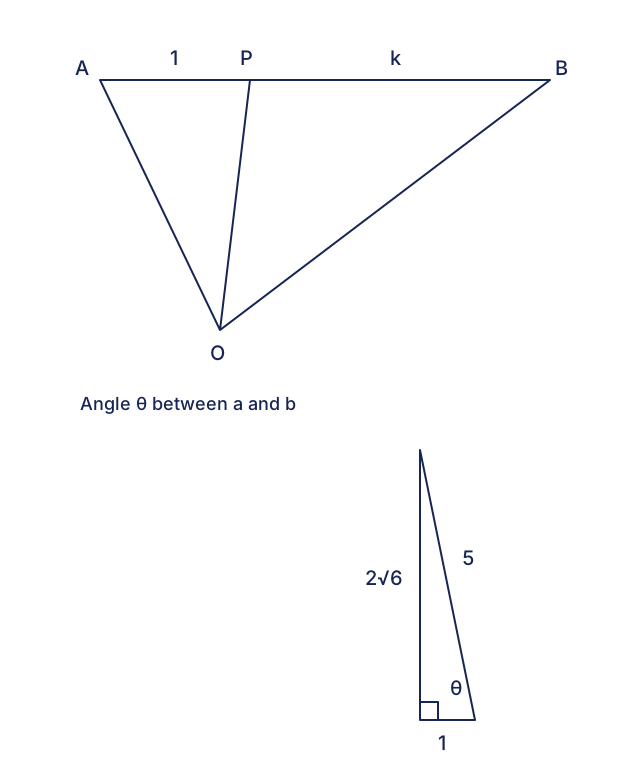
Upper sketch: P divides AB internally with AP:PB=1:k and O is off AB; O,A,P form the smaller triangle. The illustrated shape is schematic with arbitrary positive k. Lower sketch is a right triangle with adjacent side 1, opposite side 2sqrt6, hypotenuse 5, so cosθ=1/5 and sinθ=2sqrt6/5.

Common mistakes

A section ratio weights the opposite endpoint: AP:PB=1:k gives numerator ka+b.

Solution notes

All source magnitude bars, section formula, cross-product derivation and both sine methods retained. The source has two figures, reconstructed together; the section sketch is schematic and k is not fixed by its drawn lengths.

Read the hint