Porisma

Worked solution

Find a perpendicular foot on a parameterised line

With respect to O, A,B,C have position vectors a=5i+4j+10k\mathbf a=5\mathbf i+4\mathbf j+10\mathbf k, b=−4i+4j−2k\mathbf b=-4\mathbf i+4\mathbf j-2\mathbf k, c=−5i+9j+5k\mathbf c=-5\mathbf i+9\mathbf j+5\mathbf k.

(i) Find the position vector of D such that ABCD is a parallelogram. marks

(ii) N divides AB in the ratio λ:(1−λ)\lambda:(1-\lambda). Show that CN→=(10−9λ)i−5j+(5−12λ)k\overrightarrow{CN}=(10-9\lambda)\mathbf i-5\mathbf j+(5-12\lambda)\mathbf k. Hence find the position vector of N given CN is perpendicular to AB. marks

(iii) P has position vector (−1+3t)i+4j+(2+4t)k(-1+3t)\mathbf i+4\mathbf j+(2+4t)\mathbf k, where t∈Rt\in\mathbb R. Show that P is collinear with A and B for all real t. marks

[2012/SRJC/Promo/11]

CJC · Review problems · Question 4

Answer

OD=(4,9,17)OD=(4,9,17); λ=2/3\lambda=2/3, ON=(−1,4,2)ON=(-1,4,2); OP=OA+2−t3ABOP=OA+\frac{2-t}{3}AB for every real t.

(i) Complete ABCD in order

AB=b−a=(−9,0,−12)=DC=c−ODAB=\mathbf b-\mathbf a=(-9,0,-12)=DC=\mathbf c-OD. Hence OD=c−AB=(4,9,17)OD=\mathbf c-AB=(4,9,17).

How did this part go?

(ii) Apply the section formula

ON=λb+(1−λ)a=(5−9λ,4,10−12λ)ON=\lambda\mathbf b+(1-\lambda)\mathbf a=(5-9\lambda,4,10-12\lambda). Subtracting OC=(−5,9,5)OC=(-5,9,5) gives CN=(10−9λ,−5,5−12λ)CN=(10-9\lambda,-5,5-12\lambda), as required.

How did this part go?

(ii) Use the perpendicularity condition

CN⋅AB=0CN\cdot AB=0 gives −9(10−9λ)−12(5−12λ)=0-9(10-9\lambda)-12(5-12\lambda)=0. Thus −150+225λ=0-150+225\lambda=0, λ=2/3\lambda=2/3, and ON=(−1,4,2)ON=(-1,4,2). The printed intermediate line says 255λ=150255\lambda=150; its coefficient is a typo. The preceding expansion gives 225, and the printed final ratio and position are correct.

How did this part go?

(iii) Compare directions, including coincident endpoints

AB=−3(3,0,4)AB=-3(3,0,4) and AP=(−6+3t,0,−8+4t)=(t−2)(3,0,4)AP=(-6+3t,0,-8+4t)=(t-2)(3,0,4). Therefore OP=OA+2−t3ABOP=OA+\frac{2-t}{3}AB, a point on the entire line AB for every real t. The printed alternative is BP=(3+3t,0,4+4t)=(1+t)(3,0,4)BP=(3+3t,0,4+4t)=(1+t)(3,0,4). At t=2, P=A, and at t=−1, P=B; these are on the line too. Avoid dividing by t−2 or asserting a nonzero parallel vector in those cases.

How did this part go?

Compare your sketch

Expand diagram

Use the scrollbars or arrow keys to inspect details.
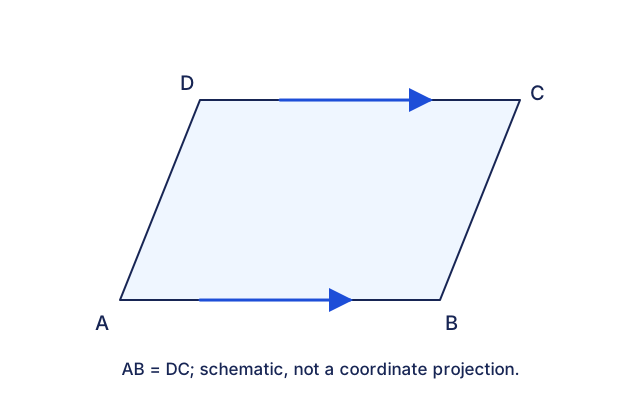
Parallelogram ABCD with A lower left,B lower right,C upper right,D upper left; arrows AB and DC have equal direction. The source page also repeats the earlier Question 2 triangle AOB with midpoint P, OQ:QP=2:1 and R on OB; that repeated drawing supplies no condition for this question. The supplementary triangle is retained in Question 2.

Common mistakes

The source has a255 coefficient typo; the correct coefficient is 225. Coincident endpoints still lie on AB.

Solution notes

All three asks and marks retained. The source page repeats the earlier Question 2 triangle unrelated to these coordinates; that diagram is retained with Question 2, not used to add conditions here. Both AP and BP methods retained; the all-real-t claim is qualified at its zero displacement cases.

Read the hint