Porisma

Worked solution

Expand a cross product for an area ratio

Referred to O, OA=aOA=\mathbf a, OB=bOB=\mathbf b, with OA perpendicular to OB. C,D lie on AB such that AC:CB=λ:(1−λ)AC:CB=\lambda:(1-\lambda) and AD:DB=μ:(1−μ)AD:DB=\mu:(1-\mu), where 0<λ<μ<10<\lambda<\mu<1.

(i) Find OC in terms of a,b,λ and OD in terms of a,b,μ. By considering their vector product, show that the area of triangle OCD is 12(μ−λ)∣a×b∣\frac12(\mu-\lambda)|\mathbf a\times\mathbf b|. marks

Now a=2i+3j−k\mathbf a=2\mathbf i+3\mathbf j-\mathbf k, b=−i+2j+4k\mathbf b=-\mathbf i+2\mathbf j+4\mathbf k and AC:CD:DB=2:3:4.

(ii) Use (i) to calculate the exact area of triangle OCD. marks

[2016/SAJC/Promo/10]

CJC · Review problems · Question 7

Answer

OC=(1−λ)a+λbOC=(1-\lambda)a+\lambda b; OD=(1−μ)a+μbOD=(1-\mu)a+\mu b; area=12(μ−λ)∣a×b∣\frac12(\mu-\lambda)|a\times b|; numeric area=76/67\sqrt6/6.

(i) Locate both section points

OC=(1−λ)a+λbOC=(1-\lambda)\mathbf a+\lambda\mathbf b and OD=(1−μ)a+μbOD=(1-\mu)\mathbf a+\mu\mathbf b.

How did this part go?

(i) Expand before taking the magnitude

OC×OD=(1−λ)(1−μ)(a×a)+(1−λ)μ(a×b)+λ(1−μ)(b×a)+λμ(b×b).\begin{aligned}&OC\times OD\\ & =(1-\lambda)(1-\mu)(\mathbf a\times\mathbf a)\\ &{}+(1-\lambda)\mu(\mathbf a\times\mathbf b)+\lambda(1-\mu)(\mathbf b\times\mathbf a)\\ &{}+\lambda\mu(\mathbf b\times\mathbf b).\end{aligned}

The self-cross-products vanish and b×a=−a×b\mathbf b\times\mathbf a=-\mathbf a\times\mathbf b. The coefficient becomes (1−λ)μ−λ(1−μ)=μ−λ(1-\lambda)\mu-\lambda(1-\mu)=\mu-\lambda. Thus area=12∣μ−λ∣∣a×b∣=12(μ−λ)∣a×b∣\frac12|\mu-\lambda||\mathbf a\times\mathbf b|=\frac12(\mu-\lambda)|\mathbf a\times\mathbf b|, since μ>λ.

How did this part go?

(ii) Use the three-part ratio

λ=2/9\lambda=2/9, μ=5/9\mu=5/9, so the area is 16∣a×b∣\frac16|\mathbf a\times\mathbf b|. The cross product is (12−(−2),−(8−1),4−(−3))=(14,−7,7)=7(2,−1,1)(12-(-2),-(8-1),4-(-3))=(14,-7,7)=7(2,-1,1). Therefore the exact area is 7622+(−1)2+12=766\frac76\sqrt{2^2+(-1)^2+1^2}=\frac{7\sqrt6}{6}.

How did this part go?

Compare your sketch

Expand diagram

Use the scrollbars or arrow keys to inspect details.
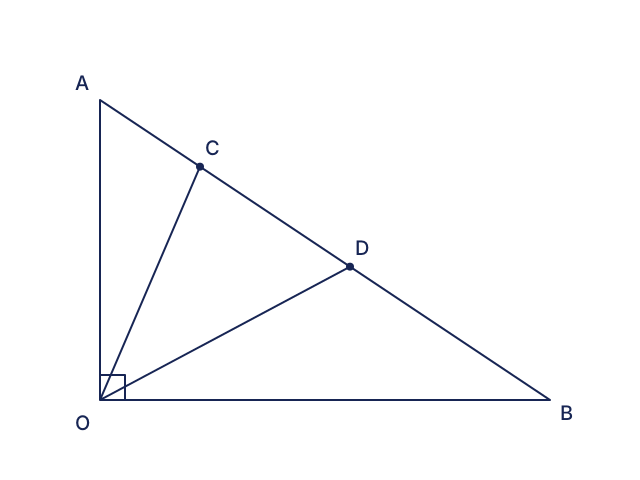
O at lower left,A above O,B to the right; OA is perpendicular to OB. C,D lie on AB in order A,C,D,B with 0<lambda<mu<1. Lines OC and OD delimit the smaller triangle OCD. Positions in this generic sketch are illustrative; the numeric case has AC:CD:DB=2:3:4.

Common mistakes

Use AD:DB, not CD:DB, to determine μ. Keep |μ−λ| until using μ>λ.

Solution notes

All printed expansion terms, ratio values, exact result and right-angle diagram retained. The numeric vectors indeed have dot product −2+6−4=0, consistent with the original perpendicular condition.

Read the hint