Worked solution
Use a projection foot to find a pyramid base area
OABC is the base of a pyramid where O is the origin. E is the highest point and D lies on OB with DE perpendicular to the base. The position vectors of A,B,C,E are respectively , , , and .
(i) Find angle AOE. marks
(ii) Find OD, the length of the projection of OE onto OB. Hence or otherwise show that D has position vector . marks
(iii) Show A,D,C are collinear. marks
(iv) Show OB is perpendicular to AC. Hence find the exact area of OABC in the form , where m is a constant to be determined. marks
[2016/DHS/Promo/11]
CJC · Review problems · Question 11
Answer
Angle 53.6°; projection length ; ; ; base area=, m=3.
(i) Find the angle between the position vectors
and give . Therefore and to 1 decimal place. The source puts an absolute value around this dot product; it is positive here, so the displayed angle is unaffected.
(ii) Find the projection length
and . Thus .
(ii) Method 1: scale the unit direction
as a vector is the projection length times the unit vector toward B: .
(ii) Method 2: impose a perpendicular displacement
Write and . Since , , so , λ=2/3 and again.
(iii) Compare two displacements from A
, whereas . With the common initial point A, this proves A,D,C are collinear and D is their midpoint.
(iv) Use perpendicular diagonals to split the base
. Both are nonzero, hence perpendicular. Triangles OAC and BAC have common base AC and heights OD, DB, so
Thus m=3.
Compare your sketch
Expand diagramFit diagram to page
Use the scrollbars or arrow keys to inspect details.
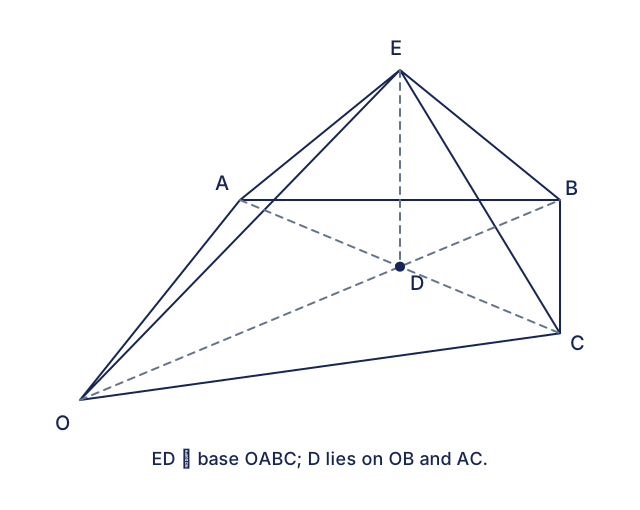
Common mistakes
Distinguish OD the length from the vector OD. The base is OABC; do not assume it is a parallelogram.
Solution notes
All four asks, both printed methods for D, base-area decomposition and pyramid figure retained. Absolute-value angle notation in the printed working is harmless for this positive dot product but is not a general angle formula.