Porisma

Worked solution

Use a projection foot to find a pyramid base area

OABC is the base of a pyramid where O is the origin. E is the highest point and D lies on OB with DE perpendicular to the base. The position vectors of A,B,C,E are respectively −7j+k-7\mathbf j+\mathbf k, 3i−9j+3k3\mathbf i-9\mathbf j+3\mathbf k, 4i−5j+3k4\mathbf i-5\mathbf j+3\mathbf k, and 6i−7j−5k6\mathbf i-7\mathbf j-5\mathbf k.

(i) Find angle AOE. marks

(ii) Find OD, the length of the projection of OE onto OB. Hence or otherwise show that D has position vector 2i−6j+2k2\mathbf i-6\mathbf j+2\mathbf k. marks

(iii) Show A,D,C are collinear. marks

(iv) Show OB is perpendicular to AC. Hence find the exact area of OABC in the form m66m\sqrt{66}, where m is a constant to be determined. marks

[2016/DHS/Promo/11]

CJC · Review problems · Question 11

Answer

Angle 53.6°; projection length 2112\sqrt{11}; OD=(2,−6,2)OD=(2,-6,2); AC=2ADAC=2AD; base area=3663\sqrt{66}, m=3.

(i) Find the angle between the position vectors

a=(0,−7,1)\mathbf a=(0,-7,1) and e=(6,−7,−5)\mathbf e=(6,-7,-5) give e⋅a=44\mathbf e\cdot\mathbf a=44. Therefore cos⁡∠AOE=44/(50110)\cos\angle AOE=44/(\sqrt{50}\sqrt{110}) and ∠AOE=53.6∘\angle AOE=53.6^\circ to 1 decimal place. The source puts an absolute value around this dot product; it is positive here, so the displayed angle is unaffected.

How did this part go?

(ii) Find the projection length

e⋅b=18+63−15=66\mathbf e\cdot\mathbf b=18+63-15=66 and ∣b∣=99=311|\mathbf b|=\sqrt{99}=3\sqrt{11}. Thus OD=∣e⋅b∣/∣b∣=66/99=211OD=|\mathbf e\cdot\mathbf b|/|\mathbf b|=66/\sqrt{99}=2\sqrt{11}.

How did this part go?

(ii) Method 1: scale the unit direction

ODOD as a vector is the projection length times the unit vector toward B: OD→=211(3,−9,3)/(311)=(2,−6,2)\overrightarrow{OD}=2\sqrt{11}(3,-9,3)/(3\sqrt{11})=(2,-6,2).

How did this part go?

(ii) Method 2: impose a perpendicular displacement

Write OD→=λb\overrightarrow{OD}=\lambda\mathbf b and ED=λb−eED=\lambda\mathbf b-\mathbf e. Since ED⋅b=0ED\cdot\mathbf b=0, λ(b⋅b)=e⋅b\lambda(\mathbf b\cdot\mathbf b)=\mathbf e\cdot\mathbf b, so 99λ=6699\lambda=66, λ=2/3 and OD→=(2,−6,2)\overrightarrow{OD}=(2,-6,2) again.

How did this part go?

(iii) Compare two displacements from A

AD=(2,−6,2)−(0,−7,1)=(2,1,1)AD=(2,-6,2)-(0,-7,1)=(2,1,1), whereas AC=(4,−5,3)−(0,−7,1)=(4,2,2)=2ADAC=(4,-5,3)-(0,-7,1)=(4,2,2)=2AD. With the common initial point A, this proves A,D,C are collinear and D is their midpoint.

How did this part go?

(iv) Use perpendicular diagonals to split the base

OB⋅AC=(3,−9,3)⋅(4,2,2)=12−18+6=0OB\cdot AC=(3,-9,3)\cdot(4,2,2)=12-18+6=0. Both are nonzero, hence perpendicular. Triangles OAC and BAC have common base AC and heights OD, DB, so

area⁡(OABC)=12OD AC+12DB AC=12OB AC=129924=366.\begin{aligned}&\operatorname{area}(OABC)\\ & =\frac12OD\,AC+\frac12DB\,AC\\ & =\frac12OB\,AC\\ & =\frac12\sqrt{99}\sqrt{24}\\ & =3\sqrt{66}.\end{aligned}

Thus m=3.

How did this part go?

Compare your sketch

Expand diagram

Use the scrollbars or arrow keys to inspect details.
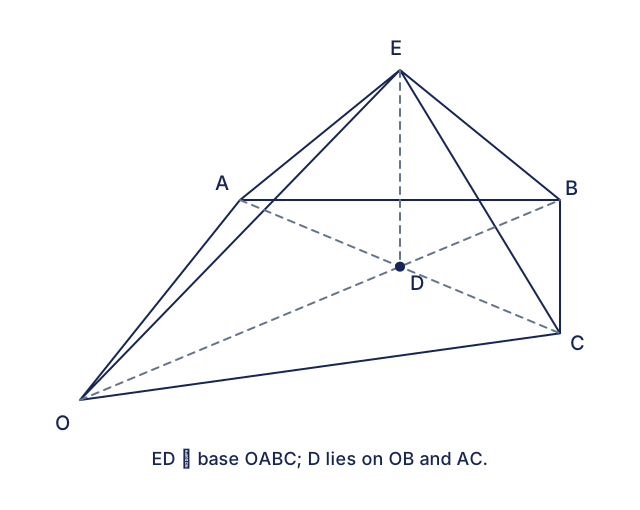
Schematic pyramid with base OABC and apex E; D lies on OB and ED is perpendicular to the base. D is also the midpoint of AC as proved. Solid edges OE, AE, BE, CE and outer base edges are shown; base diagonals AC, OB and altitude ED are dashed. The drawing is a perspective schematic, not a coordinate projection or assertion of equal side lengths.

Common mistakes

Distinguish OD the length from the vector OD. The base is OABC; do not assume it is a parallelogram.

Solution notes

All four asks, both printed methods for D, base-area decomposition and pyramid figure retained. Absolute-value angle notation in the printed working is harmless for this positive dot product but is not a general angle formula.

Read the hint