Porisma

Worked solution

Relate external division, area ratios and a unit-vector projection

Referred to O, OA=aOA=\mathbf a, OB=bOB=\mathbf b. C is on AB produced such that 2AB=3BC.

(i) Find OC in terms of a,b. marks

(ii) Show that the area of triangle OBC can be written as k∣a×b∣k|\mathbf a\times\mathbf b|, finding k. marks

(iii) D is on OB such that area (OAD):area (OBC)=4:3. Find OD in terms of b. marks

(iv) Given a,b are unit vectors and angle AOB=60°, find the length of the projection of OC onto OA. marks

[2016/PJC/Promo/11]

CJC · Review problems · Question 12

Answer

OC=5b/3−2a/3OC=5b/3-2a/3; k=1/3; OD=8b/9OD=8b/9; projection length 1/6.

(i) Apply the external section relation

OB=(2OA+3OC)/5OB=(2OA+3OC)/5. Hence OC=(5OB−2OA)/3=53b−23aOC=(5OB-2OA)/3=\frac53\mathbf b-\frac23\mathbf a.

How did this part go?

(ii) Method 1: expand the cross product

area⁡(OBC)=12∣b×(53b−23a)∣=12∣b×(−23a)∣=13∣a×b∣\operatorname{area}(OBC)=\frac12|\mathbf b\times(\frac53\mathbf b-\frac23\mathbf a)|=\frac12|\mathbf b\times(-\frac23\mathbf a)|=\frac13|\mathbf a\times\mathbf b|, using b×b=0\mathbf b\times\mathbf b=0 and reversal of cross-product order. Thus k=1/3.

How did this part go?

(ii) Method 2: use the shared altitude

Triangles OBC and OAB share the height to line ABC. Since BC/AB=2/3, area (OBC)=23area⁡(OAB)=23(12∣a×b∣)=13∣a×b∣\frac23\operatorname{area}(OAB)=\frac23(\frac12|\mathbf a\times\mathbf b|)=\frac13|\mathbf a\times\mathbf b|.

How did this part go?

(iii) Use the given ratio of nonzero areas

Write OD=λbOD=\lambda\mathbf b with 0<λ<1. Then area (OAD)=12∣a×λb∣=λ2∣a×b∣\frac12|\mathbf a\times\lambda\mathbf b|=\frac\lambda2|\mathbf a\times\mathbf b|. Dividing by area (OBC) gives (λ/2)/(1/3)=4/3(\lambda/2)/(1/3)=4/3, hence λ=8/9 and OD=89bOD=\frac89\mathbf b. The supplied area ratio presupposes nondegenerate triangles.

How did this part go?

(iv) Method 1: project onto a unit vector

Because a is unit, the projection length is ∣OC⋅a∣=∣53b⋅a−23a⋅a∣=∣53∣b∣∣a∣cos⁡60∘−23∣a∣2∣=∣5/6−2/3∣=1/6|OC\cdot\mathbf a|=|\frac53\mathbf b\cdot\mathbf a-\frac23\mathbf a\cdot\mathbf a|=|\frac53|\mathbf b||\mathbf a|\cos60^\circ-\frac23|\mathbf a|^2|=|5/6-2/3|=1/6.

How did this part go?

(iv) Method 2: use the equilateral triangle

OA=OB=1OA=OB=1 and angle AOB=60° make OAB equilateral, so AB=1 and AC=53AB=5/3AC=\frac53AB=5/3. The projection length of AC onto OA is ACcos⁡∠OAB=(5/3)cos⁡60∘=5/6AC\cos\angle OAB=(5/3)\cos60^\circ=5/6. The perpendicular foot of C is 1−5/6=1/6 from O along OA, giving the same projection length.

How did this part go?

Compare your sketch

Expand diagram

Use the scrollbars or arrow keys to inspect details.
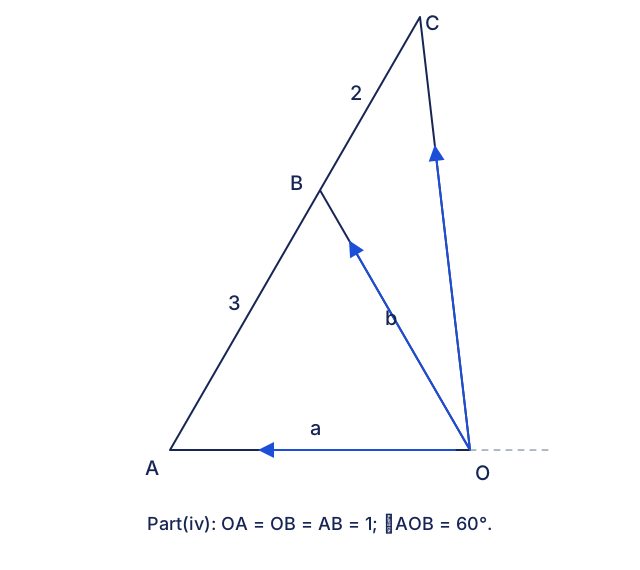
O lower right,A to its left,B up-left,C beyond B along AB, with AB:BC=3:2. In part (iv), OA and OB are unit vectors making 60 degrees, so OAB is equilateral. The figure uses exactly this special-case geometry; OC extends to the point C obtained by the 3:2 line division. Position-vector arrows point from O to A,B,C.

Common mistakes

Project onto the unit vector a; taking a dot product alone is only a length formula because |a|=1.

Solution notes

All four asks, both area methods and both projection methods retained. Source figure reconstructed using the exact geometry of part (iv), with no added generic equal-length assumption.

Read the hint