Worked solution
Relate external division, area ratios and a unit-vector projection
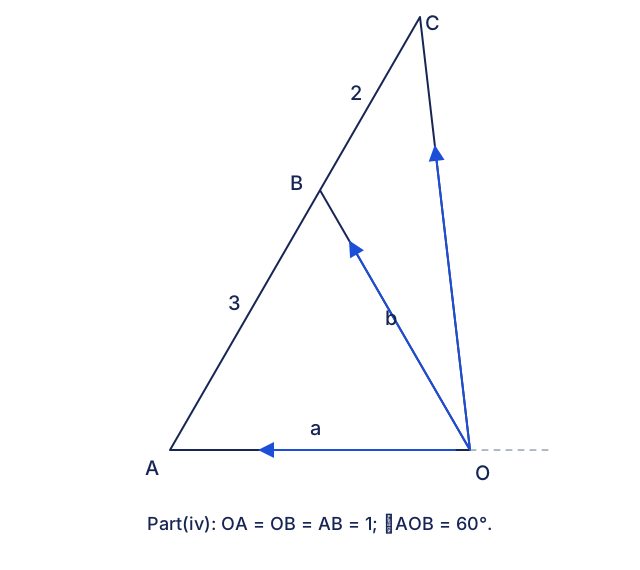
Referred to O, , . C is on AB produced such that 2AB=3BC.
(i) Find OC in terms of a,b. marks
(ii) Show that the area of triangle OBC can be written as , finding k. marks
(iii) D is on OB such that area (OAD):area (OBC)=4:3. Find OD in terms of b. marks
(iv) Given a,b are unit vectors and angle AOB=60°, find the length of the projection of OC onto OA. marks
[2016/PJC/Promo/11]
CJC · Review problems · Question 12
Answer
; k=1/3; ; projection length 1/6.
(i) Apply the external section relation
. Hence .
(ii) Method 1: expand the cross product
, using and reversal of cross-product order. Thus k=1/3.
(ii) Method 2: use the shared altitude
Triangles OBC and OAB share the height to line ABC. Since BC/AB=2/3, area (OBC)=.
(iii) Use the given ratio of nonzero areas
Write with 0<λ<1. Then area (OAD)=. Dividing by area (OBC) gives , hence λ=8/9 and . The supplied area ratio presupposes nondegenerate triangles.
(iv) Method 1: project onto a unit vector
Because a is unit, the projection length is .
(iv) Method 2: use the equilateral triangle
and angle AOB=60° make OAB equilateral, so AB=1 and . The projection length of AC onto OA is . The perpendicular foot of C is 1−5/6=1/6 from O along OA, giving the same projection length.
Compare your sketch
Expand diagramFit diagram to page
Use the scrollbars or arrow keys to inspect details.
Common mistakes
Project onto the unit vector a; taking a dot product alone is only a length formula because |a|=1.
Solution notes
All four asks, both area methods and both projection methods retained. Source figure reconstructed using the exact geometry of part (iv), with no added generic equal-length assumption.