Porisma

Worked solution

Turn a cross product with a unit direction into a distance

Referred to O, OA=aOA=\mathbf a, OB=bOB=\mathbf b. C lies on OA with OC:CA=1:2; D lies on OB with OD:DB=2:3. M is the midpoint of CD.

(i) Find OM in terms of a,b and show that the area of triangle OMD is k∣a×b∣k|\mathbf a\times\mathbf b|, finding k. marks

(ii) Now a=2i+3j+6k\mathbf a=2\mathbf i+3\mathbf j+6\mathbf k, b=10i+5j+10k\mathbf b=10\mathbf i+5\mathbf j+10\mathbf k. Find OM→×b^\overrightarrow{OM}\times\widehat{\mathbf b} and give the geometrical meaning of its magnitude. marks

[2016/SRJC/Promo/6]

CJC · Review problems · Question 14

Answer

OM=a/6+b/5OM=a/6+b/5; k=1/30; OM×b^=29(0,2,−1)OM\times\widehat b=\frac29(0,2,-1); magnitude is the distance from M to line OB.

(i) Locate C,D and their midpoint

OC=a/3OC=\mathbf a/3, OD=2b/5OD=2\mathbf b/5, so OM=12(OC+OD)=a/6+b/5OM=\frac12(OC+OD)=\mathbf a/6+\mathbf b/5.

How did this part go?

(i) Expand the area cross product

area⁡(OMD)=12∣(a/6+b/5)×(2b/5)∣=12∣(2/30)(a×b)∣=130∣a×b∣\operatorname{area}(OMD)=\frac12|(\mathbf a/6+\mathbf b/5)\times(2\mathbf b/5)|=\frac12|(2/30)(\mathbf a\times\mathbf b)|=\frac1{30}|\mathbf a\times\mathbf b|, since b×b=0\mathbf b\times\mathbf b=0. Hence k=1/30.

How did this part go?

(ii) Calculate the vector product with the unit direction

OM=16(2,3,6)+15(10,5,10)=(1/3,1/2,1)+(2,1,2)=(7/3,3/2,3)OM=\frac16(2,3,6)+\frac15(10,5,10)=(1/3,1/2,1)+(2,1,2)=(7/3,3/2,3). Since ∣b∣=225=15|\mathbf b|=\sqrt{225}=15,

OM×b^=115[(7/3,3/2,3)×(10,5,10)]=115(15−15,−(70/3−30),35/3−15)=115(0,20/3,−10/3)=29(0,2,−1).\begin{aligned}&OM\times\widehat{\mathbf b}\\ & =\frac1{15}[(7/3,3/2,3)\times(10,5,10)]\\ & =\frac1{15}(15-15,-(70/3-30),35/3-15)\\ & =\frac1{15}(0,20/3,-10/3)\\ & =\frac29(0,2,-1).\end{aligned}

How did this part go?

(ii) Interpret the magnitude

∣OM×b^∣|OM\times\widehat{\mathbf b}| is the perpendicular distance from M to the line OB. The second factor is unit length, so the cross-product magnitude is precisely the perpendicular component of OM. Its value, if desired, is 25/92\sqrt5/9.

How did this part go?

Compare your sketch

Expand diagram

Use the scrollbars or arrow keys to inspect details.
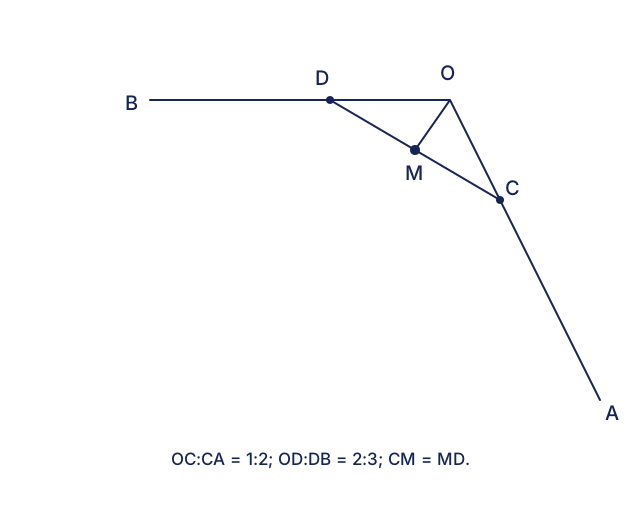
O above-right,B to its left,A below-right. D lies on OB with OD:DB=2:3; C lies on OA with OC:CA=1:2; M is the midpoint of CD. The independent schematic uses those exact fractional positions and retains the source point order, without claiming to project the later three-dimensional coordinates.

Common mistakes

The question asks for a vector product with b-hat, not b; omitting the factor 1/15 changes its magnitude.

Solution notes

All asks, exact midpoint/area/determinant working and source section diagram retained. The distance value is an explanatory addition; the printed answer gives its geometric meaning.

Read the hint