Porisma

Worked solution

Find a perpendicular foot and reflect a point in a line

Relative to O, A,B,C have position vectors 5i+4j+10k5\mathbf i+4\mathbf j+10\mathbf k, −4i+4j−2k-4\mathbf i+4\mathbf j-2\mathbf k, −5i+9j+5k-5\mathbf i+9\mathbf j+5\mathbf k.

(i) Find the Cartesian equation of AB. marks

(ii) Find the length of projection of AC onto AB. marks

(iii) Hence or otherwise find the perpendicular distance from C to AB and the position vector of its perpendicular foot N. marks

(iv) D lies on CN produced such that N is the midpoint of CD. Find the position vector of D. marks

[2000/II/15]

CJC · Review problems · Question 4

Answer

(x−5)/3=(z−10)/4(x-5)/3=(z-10)/4, y=4; projection 10; distance 50\sqrt{50}; ON=(−1,4,2)ON=(-1,4,2); OD=(3,−1,−1)OD=(3,-1,-1).

(i) Eliminate the parameter without dividing by zero

AB=(−9,0,−12)=−3(3,0,4)AB=(-9,0,-12)=-3(3,0,4). The same infinite line can use direction (3,0,4)(3,0,4): r=(5,4,10)+λ(3,0,4)\mathbf r=(5,4,10)+\lambda(3,0,4). Thus x=5+3λx=5+3\lambda, y=4, z=10+4λz=10+4\lambda, giving x−53=z−104\frac{x-5}{3}=\frac{z-10}{4}, y=4.

How did this part go?

(ii) Project onto a unit line direction

AC=(−10,5,−5)AC=(-10,5,-5). Its projection length is ∣AC⋅15(3,0,4)∣=15∣−30−20∣=10|AC\cdot\frac15(3,0,4)|=\frac15|-30-20|=10 units. This is a length; the signed component in the chosen positive direction is −10.

How did this part go?

(iii) Find the perpendicular distance

CN=∣AC∣2−AN2=100+25+25−100=50CN=\sqrt{|AC|^2-AN^2}=\sqrt{100+25+25-100}=\sqrt{50} units. The source contains a spurious extra square on the intermediate scalar sum (100+25+25); the correct squared magnitude is 150, consistent with the printed final 50\sqrt{50}.

How did this part go?

(iii) Locate the foot on AB

ON=(5+3λ,4,10+4λ)ON=(5+3\lambda,4,10+4\lambda) gives CN=(10+3λ,−5,5+4λ)CN=(10+3\lambda,-5,5+4\lambda). Enforcing perpendicularity to (3,0,4)(3,0,4) gives 30+9λ+20+16λ=030+9\lambda+20+16\lambda=0, hence λ=−2 and ON=(−1,4,2)ON=(-1,4,2).

How did this part go?

(iv) Reflect C across the foot

ON=12(OC+OD)ON=\frac12(OC+OD), so OD=2ON−OC=2(−1,4,2)−(−5,9,5)=(3,−1,−1)OD=2ON-OC=2(-1,4,2)-(-5,9,5)=(3,-1,-1).

How did this part go?

Compare your sketch

Expand diagram

Use the scrollbars or arrow keys to inspect details.
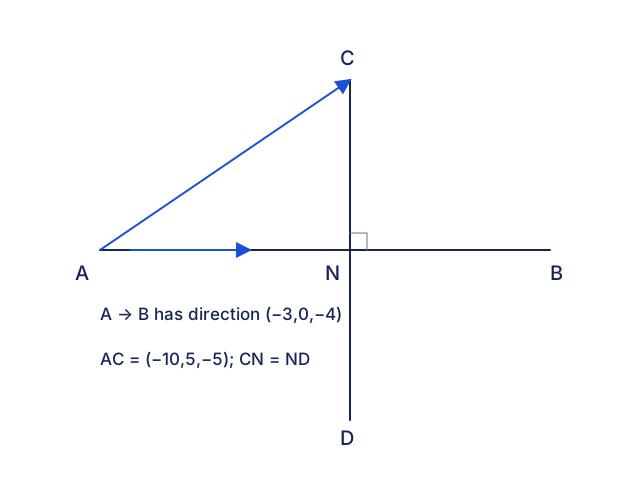
Planar schematic: A,N,B are collinear in that order; C,N,D lie on a perpendicular with CN=ND. N is the foot from C and midpoint of CD. The source illustrates these incidences but its arrow labelled (3,0,4) points towards B even though AB is −3(3,0,4); this redrawing labels the line with the correctly oriented AB direction. It is not a projection of the spatial coordinates.

Common mistakes

The sign of a direction vector does not change the infinite line or a projection length. The source diagram direction arrow and one squared-norm line need qualification.

Solution notes

All four asks, complete algebra and original diagram incidences retained. PDF 5 is intentionally blank except for its printed page number; inspected and retained in native text. Source arrow sign and the extra square on PDF 6 are explicitly corrected, preserving original extraction.

Read the hint