Worked solution
Find a projection foot using two methods
Relative to O, A,B,C have position vectors , , and respectively, where α,β are real.
(i) Given , find α,β. marks
(ii) Find the length of projection of AB onto BC. marks
(iii) Hence or otherwise find the position vector of the perpendicular foot from A to BC. marks
(iv) Find the exact area of triangle ABC. marks
[2008/NYJC/Promo/8]
CJC · Review problems · Question 5
Answer
α=−2,β=3; projection 10; ; area .
(i) Put C on the line
, β=3 and . Thus λ=−3, α=−2 and β=3, giving C=(−2,3,−6).
(ii) Project onto the line direction
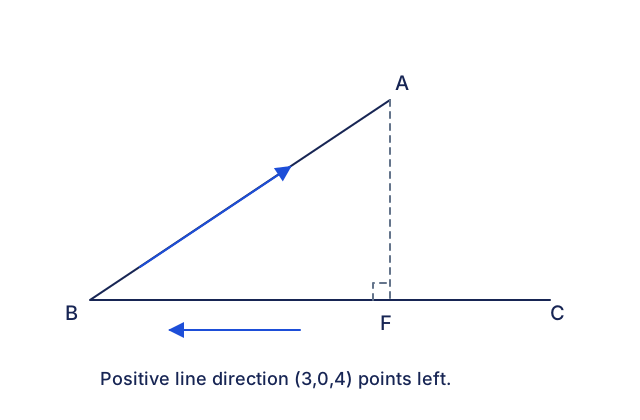
Let F be the perpendicular foot. , so the projection length is . Reversing BA to the asked AB changes the sign but not this length.
(iii) Hence method: retain the projection sign
. Therefore , and . The source writes length BF before introducing −10; the sign comes from the signed dot product, not from a negative length.
(iii) Otherwise method: a zero perpendicular dot product
gives . Thus , λ=−2 and .
(iv) Method 1: cross product
and . The area is square units.
(iv) Method 2: base and perpendicular height
and BC=15. Hence area= square units.
Compare your sketch
Expand diagramFit diagram to page
Use the scrollbars or arrow keys to inspect details.
Common mistakes
The direction(3,0,4) points opposite to BC; a positive length alone cannot determine the foot’s displacement.
Solution notes
All asks, both foot methods and both area methods retained. The source switch from a length 10 to signed −10 is explicitly justified. Source diagram independently reconstructed.