Worked solution
Separate a trigonometric parameter from a later special case
With respect to O, A,B,C have position vectors , , , where .
(a) Find the exact t given a is perpendicular to b. marks
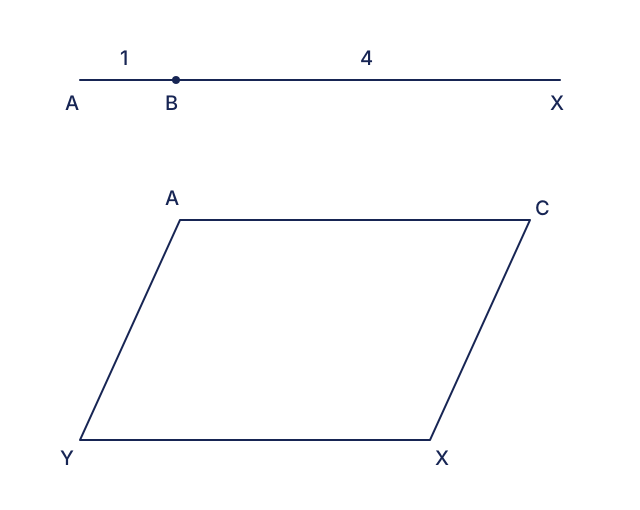
(b) X is on AB produced with AB:BX=1:4, and ACXY is a parallelogram. Take for the rest of the question.
(i) Find the position vectors of X,Y. marks
(ii) Find the area of ACXY. Hence find the shortest distance from X to line AC. marks
(iii) Line has equation , z=k, where h,k are constants. The line through A,B intersects at a right angle. Find h,k. marks
[2012/HCI/Promo/13]
CJC · Review problems · Question 8
Answer
(a); (b),; area ; distance ≈7.64; h=−6,k=1/2.
(a) Use the specified quadrant
, so . The basic angle is . Since 0≤t<π and tan t<0, t lies in quadrant 2: . The case cos t=0 does not satisfy the original equation.
(b)(i) Reset t and locate X,Y
At t=π/2, , , and . Since AX=5AB, . The order ACXY gives , so .
(b)(ii) Area and height to AC
, and . Hence area (ACXY)=. Taking AC as the base gives shortest distance XN=, or 7.64 units(3s.f.).
(b)(iii) Enforce orthogonality and intersection separately
; line AB:. The directions have dot product −6−h, giving h=−6. At an intersection, , , . Solving gives λ=−1/4, μ=1/2, hence k=1/2. The two parameters must be independent despite a reused λ in one printed vector-equation line.
Compare your sketch
Expand diagramFit diagram to page
Use the scrollbars or arrow keys to inspect details.
Common mistakes
Orthogonality gives h, while intersection supplies k. Neither condition alone is sufficient.
Solution notes
Every printed ask, quadrant note, calculations and both sketches retained. The independent line parameters in the printed subsequent scalar equations resolve a parameter-letter reuse in its preceding vector line.