Worked solution
Prove a rhombus using a perpendicular projection
Relative to O, A,B,C have position vectors , , . Line through A,C has equation .
(i) Show λ=−5. marks
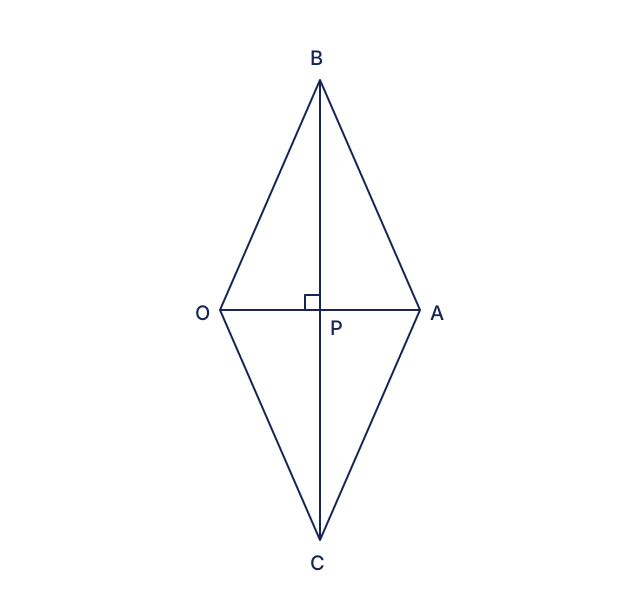
(ii) Find the position vector of P on OA with BP perpendicular to OA. Hence or otherwise prove OBAC is a rhombus. marks
(iii) Find the area of OBAC. marks
(iv) Line passes through O,Q, where Q lies on BA produced with BA/BQ=1/4. Find the acute angle between . marks
[2016/AJC/Promo/7]
CJC · Review problems · Question 9
Answer
λ=−5; ; OBAC is a rhombus; area 40.8 units²(3s.f.) or exactly; angle 18.5°.
(i) Method 1: use a vector parameter
. At C=(0,λ,12), the coordinates give , , . Thus μ=−1 and λ=−5.
(i) Method 2: substitute in the Cartesian equation
At C=(0,λ,12), , giving λ=−5 directly.
(ii) Method 1: vector projection
.
(ii) Method 2: impose perpendicularity
Write , so . Then , hence k=1/2, giving the same .
(ii) Prove the specific quadrilateral is a rhombus
, or equivalently , so OBAC is a parallelogram. Its adjacent sides satisfy , making it a rhombus. The source alternative uses the parallelogram together with ; the perpendicular diagonals of a parallelogram also establish a rhombus. Here , so the perpendicularity follows from BP⊥OA.
(iii) Use four right triangles
and . Hence
square units(3s.f.), as printed. The corresponding exact value is square units.
(iv) Find Q, then an acute angle
, hence . The other direction is . Thus
and θ=18.5°.
Compare your sketch
Expand diagramFit diagram to page
Use the scrollbars or arrow keys to inspect details.
Common mistakes
Perpendicular diagonals alone do not establish a rhombus for an arbitrary quadrilateral.
Solution notes
Both printed λ methods and both foot methods retained, with both rhombus criteria and source area/angle working. The reconstructed rhombus includes the incidences in the source proof sketch. Exact area is an explanatory addition to the printed 3s.f. answer.