Worked solution
Distinguish a geometric flight path from motion in time
Distances are in metres and time in seconds. A radio-controlled airplane takes off from ground level and travels at a steady speed in a straight line. Its position t seconds after takeoff is , where a is its departure position and b its velocity vector.
(i) After 6 seconds it reaches P=(−9,4,6) and its velocity is . Find its departure coordinates. mark
Paul stands at C=(−7,5,2).
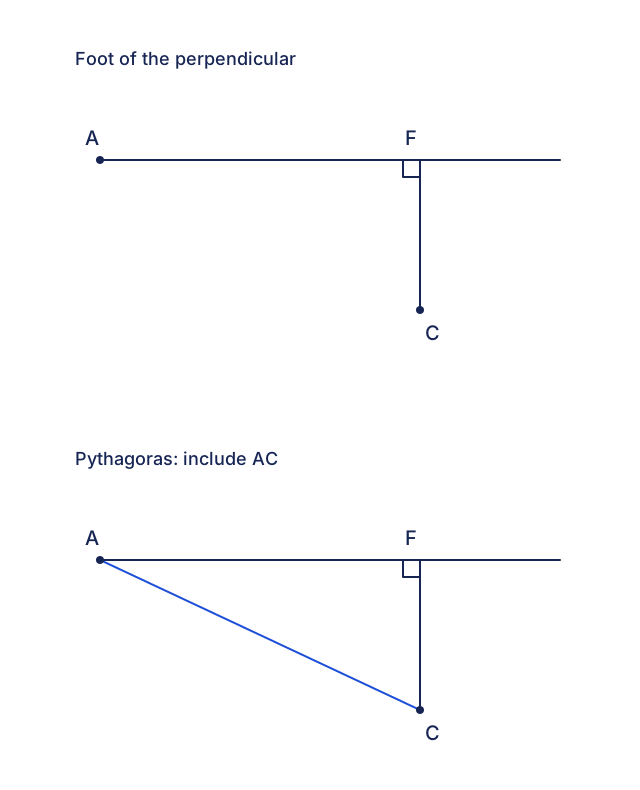
(ii) Find the shortest distance from Paul to the airplane’s flight path. marks
A drone takes off at the same time and flies at steady speed on the straight line .
(iii) Show its flight path can be written , λ≥0, determining p,q. mark
(iv) Given the flight paths intersect, find k. marks
(v) Do the airplane and drone collide? Justify your answer. mark
[2019/MI/I/11]
CJC · Review problems · Question 11
Answer
A=(3,−2,0); distance ≈3.58m; p=(1/2,−7,10),q=(−3,4,k); k=−2. Printed (v): no collision under λ=time. As written, drone speed/time data are insufficient to decide collision.
(i) Recover the departure point
Write . At t=6, , so . Departure is A=(3,−2,0), consistent with ground level.
(ii) Method 1: solve for the perpendicular foot
and . A perpendicular foot satisfies . Thus ≈4.83333≥0, so the foot is on the flown ray. Then and m(3s.f.).
(ii) Method 2: use a vector product
. The distance is m(3s.f.). The valid positive foot parameter from method 1 ensures this line distance is also the ray distance.
(ii) Method 3: use projection and Pythagoras
. Thus distance=m(3s.f.).
(iii) Convert the Cartesian equation
Set the common ratio to λ: , , . Hence the requested path representation is , λ≥0. Thus and .
(iv) Match positions using independent parameters
At an intersection, . Coordinates give , , . The first two yield λ=2.5 and t=5; the third gives , so k=−2. Both parameters are nonnegative and the intersection is (−7,3,5).
(v) Printed answer and the missing motion assumption
The printed solution says “No collision” because λ=2.5 and t=5 are different arrival times. That conclusion requires the extra assumption that λ is elapsed time in seconds from a drone starting at p at takeoff, with velocity q. The prompt specifies only a steady-speed path for the drone, not that time parameterisation. Geometric parameters need not equal time. If λ(t)=t, it does not collide; if λ(t)=t/2 from the same starting point, it reaches the intersection at t=5 and does collide. Both motions have steady speed. Therefore the collision cannot be determined from the stated path and simultaneous takeoff alone; drone velocity or an explicit λ=time condition is needed.
Compare your sketch
Expand diagramFit diagram to page
Use the scrollbars or arrow keys to inspect details.
Common mistakes
The drone’s geometric parameter λ is not identified with seconds by its Cartesian line equation.
Solution notes
All 5 asks, all 3 distance methods, both source right-triangle diagrams, path conversion and intersection working retained. The final printed no-collision conclusion is preserved and explicitly qualified: unequal geometric parameter values are not proof of unequal times without a specified drone velocity/time model. The requested λ≥0 path is retained; the distance foot is after takeoff.