Worked solution
Rational curve and ellipse: exactly two intersections
Sketch the graph of , where is a positive constant, indicating clearly any axial intercept(s), asymptote(s) and coordinates of turning point(s).
Given , deduce the range of values of in terms of , such that the graphs of and intersect twice, where and are positive real numbers.
[2010/NJC/Promo/6]
CJC · Discussion · Question 3
Answer
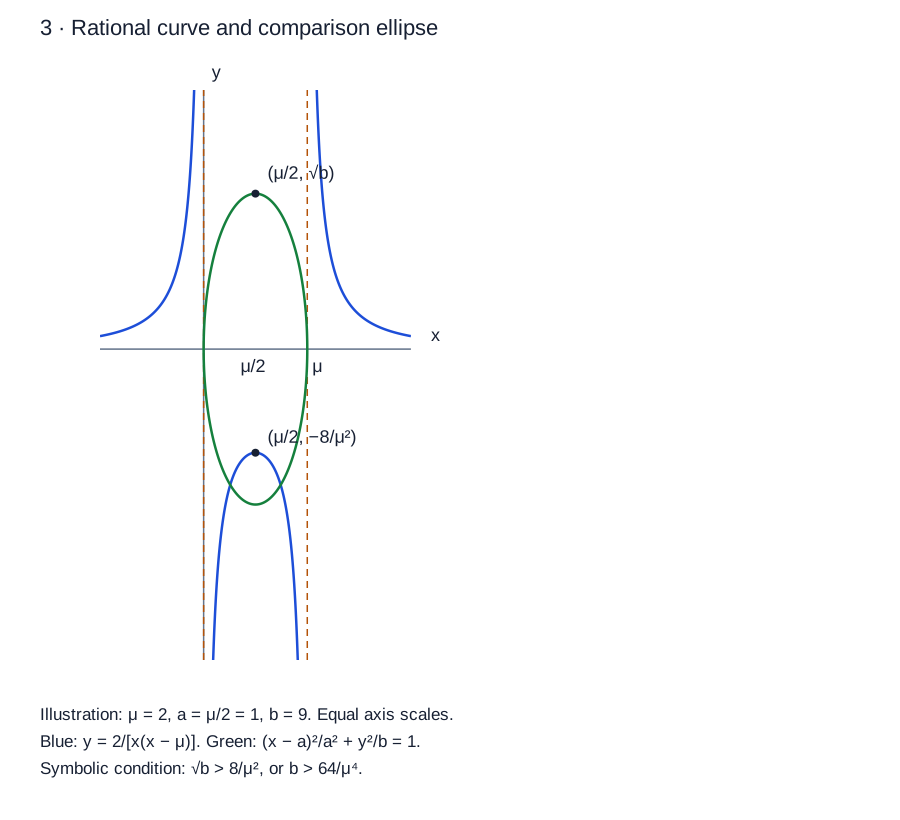
Asymptotes: , , ; turning point ; no axial intercepts. Exactly two intersections when .
Rational sketch
There are no axial intercepts: the numerator never vanishes and is excluded. Asymptotes are . Differentiate: . Hence the sole stationary point is , a maximum on the negative middle branch. The exterior branches are positive. The graph is symmetric about .
Ellipse comparison
Divide by : . Centre , horizontal semi-axis , vertical semi-axis . The ellipse occupies , and the rational graph is negative there. The lower ellipse must extend below the rational maximum: , hence . Equality gives one tangent intersection; a smaller gives none. To check that the strict condition gives exactly two, write , . Equating squared ordinates gives , or . There is a unique admissible exactly when , and it yields two symmetric nonzero values of .
Compare your sketch
Expand diagramFit diagram to page
Use the scrollbars or arrow keys to inspect details.
Solution notes
The source has separate rational-curve and ellipse sketches; the reconstruction overlays both while retaining all their symbolic labels. Geometry uses the explicitly labelled example μ=2,b=9.