Worked solution
Rational curve: coefficients, hyperbola comparison and stationary points
The curve has equation , where , and are non-zero constants.
(a) It is given that passes through the point and has a minimum point at .
(i) Find the values of , and .
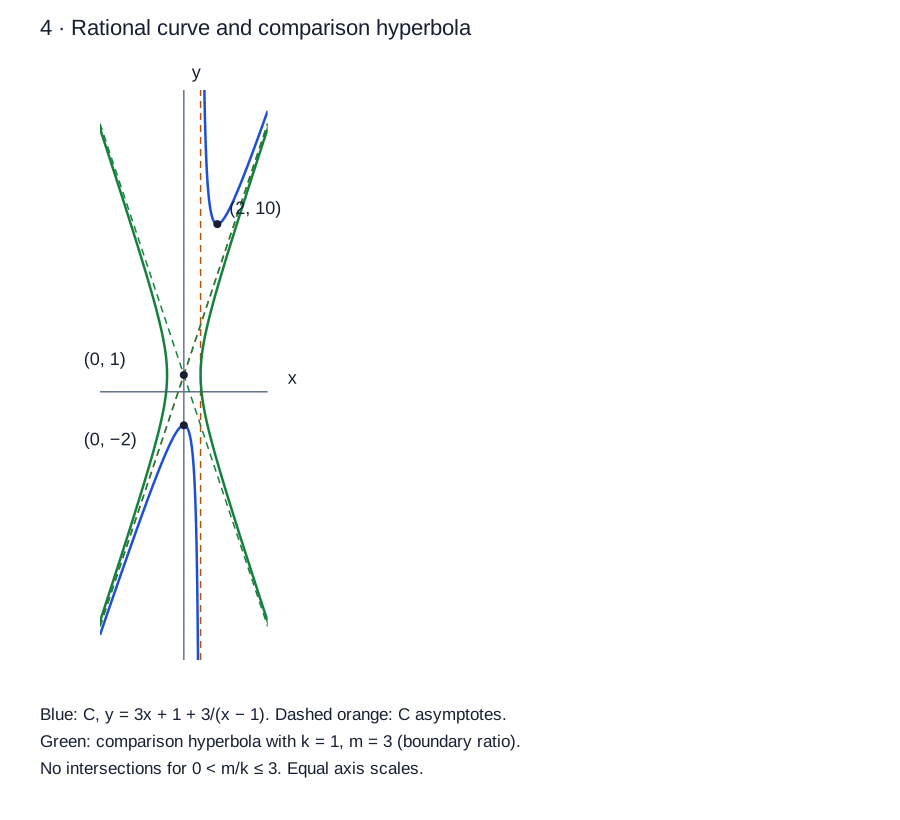
(ii) Sketch , giving the coordinates of any turning points, points of intersection with the axes and the equations of any asymptotes.
(iii) Find the set of values of , where and are positive constants, such that the curve with equation does not intersect .
(b) In the case when and , find the set of values of , where , such that has no stationary point.
[2013/VJC/II/2]
CJC · Discussion · Question 4
Answer
(a)(i) . (ii) Maximum , minimum ; -intercept ; no -intercepts; asymptotes , . (iii) . (b) (the question excludes ).
(a)(i)
The points give and . The derivative is ; stationarity at gives . Solving these three equations (the source uses a GC) gives . The lecturer guidance in the Conics Teacher copy (PDF 28, printed 140) recommends using a system of linear equations (SOLE) for these three conditions. Set up all three equations before solving for ; reviewing simultaneous equations in advance helps. This makes the source’s GC solution a system-solving step rather than an unexplained coefficient guess.
(a)(ii)
Long division gives . The asymptotes are and . Since , stationary inputs are , giving a maximum and minimum . The sole axial intersection is : has negative discriminant , so no real -intercepts.
(a)(iii)
The comparison hyperbola has centre and asymptotes . Comparing the positive-gradient asymptote with gives the source answer , including equality. For a check beyond the sketch, put . At an intersection, and . If or , . For , because . Thus every intersection requires . Conversely for any fixed , on this ratio is continuous, tends to infinity at the left boundary and to as , so every produces an intersection. Therefore is exact.
(b)
With , . For no stationary input, the numerator quadratic must have negative discriminant: , so . For , its two roots are in the domain. The source separately notes that at , for , also with no stationary point, but that case is explicitly excluded in the question.
Compare your sketch
Expand diagramFit diagram to page
Use the scrollbars or arrow keys to inspect details.
Common mistakes
Equal asymptote gradients do not imply the curves intersect. Here the boundary ratio m/k=3 is included.
Solution notes
The source’s “stationary points of c” in (b) means stationary points of C. Its original wording/extraction is retained. The comparison graph explicitly uses k=1,m=3; the proof covers all positive k,m.
Teacher guidance additionally compared against Conics Lecture Teacher PDF 28 / printed 140 and integrated into (a)(i); review retained in evidence/review-cjc-conics-lecture.md.