Worked solution
Solve and assess an exponential rod-expansion model
When a metal rod is heated, its length increases at a rate proportional to .
(i) Write a differential equation for in terms of .
(ii) Show that its general solution is .
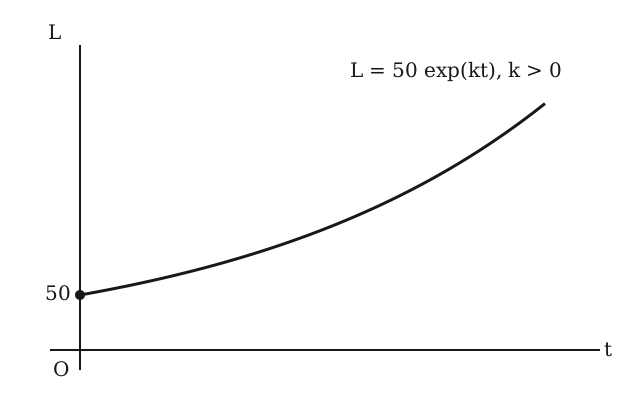
(iii) The initial length is cm. Sketch against .
(iv) Explain why this differential equation does not appropriately describe the expansion of the heated rod.
[2006/RJC/Promo/11]
CJC · Discussion · Question 7
Answer
, ; initially , whose unlimited growth exposes the model limitation.
(i) Translate proportionality into an equation
, with because the length is increasing.
(ii) Separate using the positive physical length
gives since . Thus , with .
(iii) Apply the initial length and sketch
gives , so for . The graph starts at , is increasing and curves upwards.
(iv) Explain the model limitation
For constant , the model predicts unbounded, ever-faster growth as increases. The printed solution states that expansion cannot be non-terminating; this unlimited exponential prediction does not appropriately describe a heated metal rod over indefinitely long times.
Compare your sketch
Expand diagramFit diagram to page
Use the scrollbars or arrow keys to inspect details.
Common mistakes
Solving a model correctly does not establish that its long-term physical prediction is appropriate.