Porisma

Worked solution

Model warming towards room temperature

A bottle of liquid is removed from a refrigerator into a room at constant 20∘20^\circC. Its temperature θ\theta degrees Celsius after tt minutes increases at a rate proportional to (20−θ)(20-\theta). Initially θ=10\theta=10 and dθ/dt=1d\theta/dt=1 degree Celsius per minute. Set up and solve a differential equation to show that θ=20−10e−t/10\theta=20-10e^{-t/10}. Find the time to reach 15∘15^\circC, state the large-tt behaviour, and sketch θ\theta against tt.

[N2010/I/7]

CJC · Discussion · Question 8

Answer

θ=20−10e−t/10\theta=20-10e^{-t/10}; 15∘15^\circC after 10ln⁡2≈6.9310\ln2\approx6.93 minutes; θ→20\theta\to20 from below.

Use the initial warming rate to find the constant

dθ/dt=k(20−θ)d\theta/dt=k(20-\theta) with k>0k>0. At t=0t=0, 1=k(20−10)1=k(20-10) gives k=1/10k=1/10 per minute.

How did this part go?

Separate and apply the initial temperature

∫dθ/(20−θ)=∫dt/10\int d\theta/(20-\theta)=\int dt/10 gives −ln⁡(20−θ)=t/10+C-\ln(20-\theta)=t/10+C on the branch below room temperature. Thus 20−θ=Ae−t/1020-\theta=Ae^{-t/10}. Since θ(0)=10\theta(0)=10, A=10A=10 and θ=20−10e−t/10\theta=20-10e^{-t/10}.

How did this part go?

Find the requested time and sketch the limit

At θ=15\theta=15, e−t/10=1/2e^{-t/10}=1/2, so t=10ln⁡2≈6.93t=10\ln2\approx6.93 minutes. For t≥0t\ge0 the graph starts at (0,10)(0,10), rises with decreasing gradient and tends to the horizontal asymptote θ=20\theta=20. It remains below 2020 at every finite time.

How did this part go?

Compare your sketch

Expand diagram

Use the scrollbars or arrow keys to inspect details.
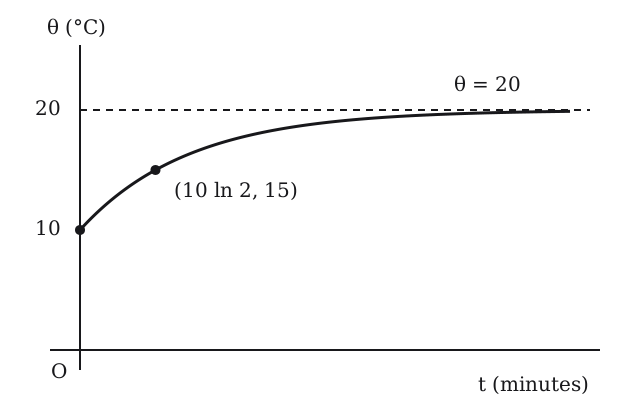
Liquid temperature theta=20 minus 10 exp(−t/10) for t at least zero: starts at (0,10), rises concave down through (10 ln2,15), and approaches the dashed horizontal asymptote theta=20 from below.

Common mistakes

Approaching the room temperature does not mean reaching it at a finite time.

Read the hint