Worked solution
A restricted parabola and its inverse
The function is defined by for , .
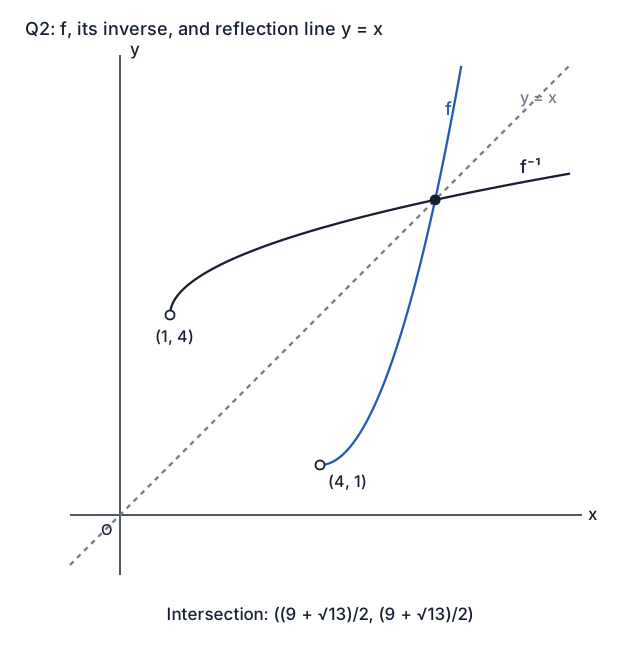
(i) Sketch the graph of . Your sketch should indicate the position of the graph in relation to the origin.
(ii) Find , stating the domain of .
(iii) On the same diagram as in part (i), sketch the graph of .
(iv) Write down the equation of the line in which the graph of must be reflected in order to obtain the graph of , and hence find the exact solution of the equation .
[2008/II/4]
CJC · Functions · Discussion 2 · 2025
Answer
(ii) , . (iv) Reflection line ; .
(i)
The graph is the increasing right branch of the parabola with vertex (4,1), but the vertex is excluded because x>4. Draw an open endpoint at (4,1) and show the axes and origin. The graph lies to the right of x=4 and above y=1.
(ii)
Let , so . From , obtain and . The negative branch fails x>4. Therefore , with . The inverse has range (4,∞).
(iii)
Reflect the original curve in y=x. The inverse is the increasing square-root curve with open endpoint (1,4). Keep both curves and the reflection line on one set of axes.
(iv)
The reflection line is y=x. The source sketch has one intersection, lying on this line. Solve , giving , so . Reject the smaller value because x>4; the exact solution is . As an independent justification, a strictly increasing function cannot have an off-diagonal two-cycle: f(x)>x would imply f(f(x))>f(x), and f(x)<x gives the reverse contradiction. Thus equality with its inverse here forces a fixed point.
Compare your sketch
Expand diagramFit diagram to page
Use the scrollbars or arrow keys to inspect details.
Common mistakes
Both endpoints are open. The fixed-point shortcut is justified by increase here; it is not a rule for every function.