Worked solution
Find the spending rejection boundary without over-rounding
A department store reports that average spending per customer over the past six months is $215 with standard deviation $100. During a week-long sales promotion, it takes a random sample of 100 visiting customers and records their spending. It tests at 5% whether the promotion increased average spending.
(i) State, with a reason, whether the test requires assuming normally distributed customer spending.
(ii) State the null and alternative hypotheses. Given that the null hypothesis is rejected, show that the sample mean is greater than $231.45.
[2007/SAJC/II/11(a)]
CJC · Discussion · Question 3
Answer
No individual normality assumption is required for the source CLT test. , ; exact normal-approximation rejection condition . The printed strict bound is overstrong.
(i) CLT applies to the sample mean
With independent representative observations and a stable finite variance, the source uses CLT for ; individual spending need not itself be normal. The sample mean, not each customer’s spending, is approximately normal. Retaining the historical SD 100 for the promotion population is an additional model assumption.
(ii) p-value and critical-value routes
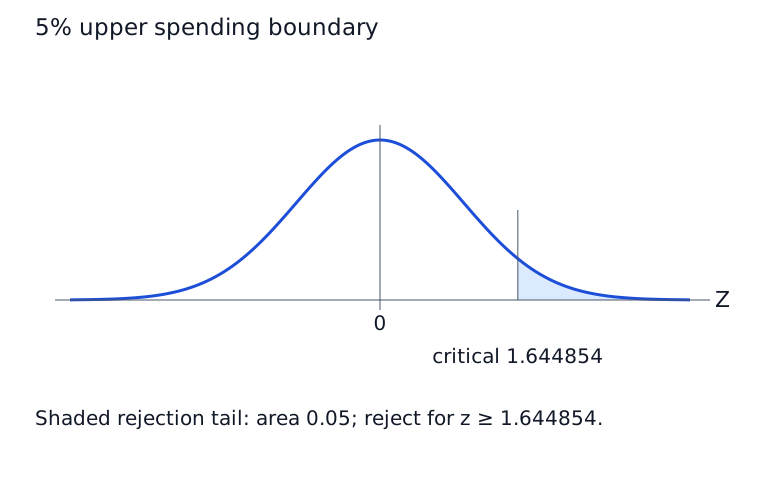
Test against . Under , . Rejection with the source convention means , or . Both methods give
(ii) Qualify the printed “show” statement
The question asks for while its working states after rounding. Neither is the exact real-valued rejection boundary. For example, 231.449 exceeds 231.4485362695 and rejects, but is below 231.45. Thus the requested strict bound does not follow as stated. The boundary rounds to 231.45; if the mean itself is restricted to a 0.01 grid, the least rejecting grid value is 231.45, with equality included. Do not infer that grid merely from individual prices being in cents.
Compare your sketch
Expand diagramFit diagram to page
Use the scrollbars or arrow keys to inspect details.
Common mistakes
Keep the full critical boundary before comparing real-valued means. The source’s rounded ≥ statement and the question’s > statement are not interchangeable.