Worked solution
Use the specified substitutions
Use the given substitutions to find the following integrals:
(a) , let .
(b) , let .
(c) , let .
(d) , let .
(e) , let .
(f) , let .
CJC · Discussion · Question 7
Answer
(a) .
(b) .
(c) .
(d) .
(e) .
(f) .
(a)
With , and . The integral becomes .
(b)
With , and . Thus the integral is . It equals .
(c)
With , and . Then . This gives . The logarithm argument is positive on x≥0; the substitution calculation applies first on x>0.
(d)
With , . The transformed integrand is . Integrate to get . The final expression differentiates correctly even at points where the substitution division by sin x was only locally valid.
(e)
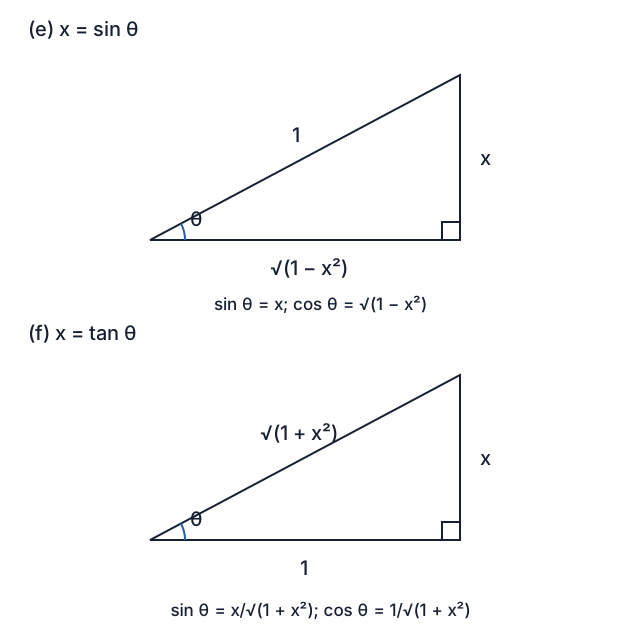
Take the principal substitution , with , so and . The integral becomes . The source triangle has hypotenuse 1, opposite side x and adjacent side √(1−x²). For negative x the signed principal-angle formulas, rather than a negative side length, justify the same result.
(f)
With on , . The integral becomes . This is . The source triangle has opposite side x, adjacent side 1 and hypotenuse √(1+x²). Using , and gives .
Compare your sketch
Expand diagramFit diagram to page
Use the scrollbars or arrow keys to inspect details.
Common mistakes
For the sine substitution use a branch with cos θ>0; √(cos²θ) is |cos θ| before a branch is chosen.
Solution notes
The source prints unsigned right triangles for (e) and (f). These are independently reconstructed as ratio aids for nonnegative x; the stated principal branches supply the signed formulas when x<0. The branch qualification is an authored supplement, not a restriction added to the original integrals.