Worked solution
Separate disjoint cases from inclusion–exclusion
Find the number of arrangements of the 6 letters in the word ELEVEN in which
(i) there are no restrictions,
(ii) all the 3 letters E are consecutive,
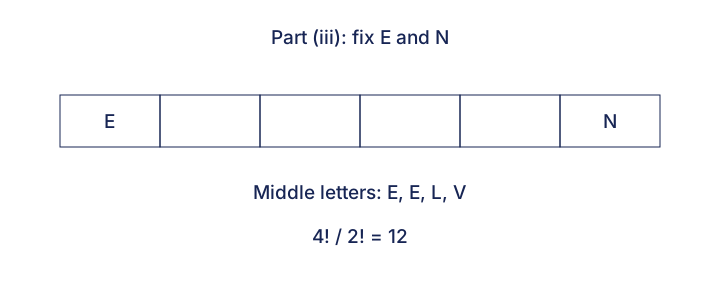
(iii) the first letter is E and the last letter is N,
(iv) the first letter is E or the last letter is N or both.
[J1986/I/10]
CJC · Discussion · Question 5
Answer
(i) 120; (ii) 24; (iii) 12; (iv) 68.
(i) Repeated letters
There are three identical E’s and one each of L, V and N. Thus .
(ii) One EEE block
Treat EEE, L, V and N as four objects. The E’s have only one internal order, giving .
(iii) Fix both endpoints
Fix E first and N last. The four middle letters are E, E, L and V, so their arrangements number .
(iv) Method 1: three disjoint cases
First E and last not N: if the last letter is L or V, there are arrangements of the remaining middle letters; if it is E, there are . This case totals 48. First not E and last N: the first letter is L or V, giving . First E and last N gives 12 from (iii). The disjoint total is .
(iv) Method 2: inclusion–exclusion
First E gives arrangements of E, E, L, V, N in the remaining positions. Last N gives arrangements of E, E, E, L, V. Their intersection, first E and last N, was counted twice and has size 12. Hence .
Compare your sketch
Expand diagramFit diagram to page
Use the scrollbars or arrow keys to inspect details.
Common mistakes
The two endpoint conditions overlap. Adding their individual counts without correction double-counts part (iii).
Solution notes
All printed asks, working, counting factors and source annotations visually compared and retained. No marks are printed for this question.