Worked solution
Keep a fixed-order block and separate two books
4 distinct green books, 4 distinct blue books and 2 distinct red books are arranged on a shelf. The green books are always placed together in the same order, but the red books are always separated. Calculate the number of ways in which this can be done.
CJC · Discussion · Question 6
Answer
3600 arrangements.
Method 1: use the six gaps
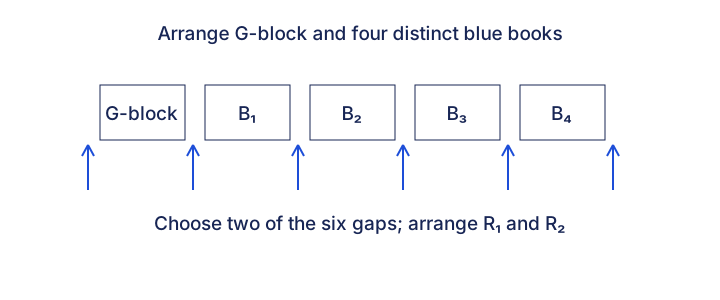
Treat the four green books as one block with its prescribed internal order. Arrange this block and the four distinct blue books in ways. Their six gaps include both ends. Choose two different gaps for the red books and arrange the two distinct reds: .
Method 2: retain the source complement argument
With the green block fixed internally, there are unrestricted arrangements of it, four blue books and two red books. If the two reds are adjacent, group them too: . Subtract: . The source labels this method “Not Recommended”: its single adjacent-pair complement works here because exactly two objects must be separated. With three or more, “not all together” does not mean pairwise separated.
Compare your sketch
Expand diagramFit diagram to page
Use the scrollbars or arrow keys to inspect details.
Common mistakes
Do not multiply by 4! for the green books: their internal order is fixed. The separation complement requires care beyond two red books.
Solution notes
All printed asks, working, counting factors and source annotations visually compared and retained. No marks are printed for this question.