Worked solution
Distinguish circular rotations from numbered seats
Three single men, two single women and two families take their places at a round table. Each of the two families consists of two parents and one child. Find the number of possible seating arrangements if
(i) members of the same family are seated together and the two single women are separated,
(ii) the seats are numbered and each child sits between their parents.
[2007/HCI/II/5]
CJC · Discussion · Question 8
Answer
(i) 17280; (ii) 31680.
(i) Method 1: circular gaps
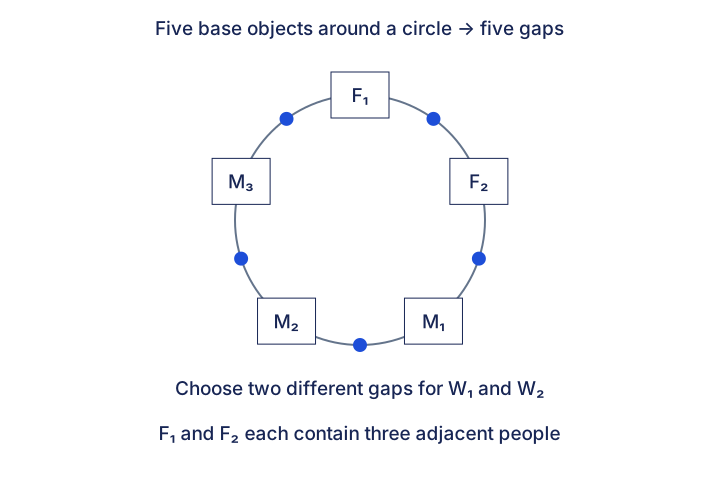
Group each family as F₁ or F₂ and label the single men M₁, M₂, M₃. Arrange these five distinguishable objects in a circle in ways, using one man as a reference. Each family has internal orders. There are five circular gaps, including the gap across the chosen reference; choose two different gaps for the women and arrange them in ways. Thus .
(i) Method 2: the printed complement alternative
The source marks this “Not recommended”. Without separating the women, seven circular objects give . If the two women form a block, six circular objects give . Hence . As the source warns, subtracting a single together-case establishes separation here because only two objects are being separated; it does not generalise directly to pairwise separation of three or more.
(ii) Numbered seats and a child between parents
Each family is a consecutive parent–child–parent block, with possible parent orders. There are seven objects around a circle, so circular arrangements. There are 11 individual people and 11 numbered seats. After using M₁ as the circular reference, assign its seat in 11 ways: . Part (ii) does not retain part (i)’s condition separating the two single women.
Compare your sketch
Expand diagramFit diagram to page
Use the scrollbars or arrow keys to inspect details.
Common mistakes
Numbered seats distinguish rotations of the complete 11-person arrangement; the multiplier is 11, not the 7 compressed blocks.
Solution notes
All printed asks, working, counting factors and source annotations visually compared and retained. No marks are printed for this question.
PDF/printed page 8 is blank apart from the running header/footer. It is retained with the preceding Q8 solution for complete source pagination; no extra exercise or working is inferred.