Worked solution
Join overlapping card blocks before arranging the remaining cards
A children’s game is played with 20 cards, consisting of 5 sets of 4 cards. Each set consists of a father, mother, daughter and son from the same family. The family names are Red, Blue, Green, Yellow and Orange. For example, the Red family cards are father Red, mother Red, daughter Red and son Red.
The 20 cards are arranged in a row.
(i) In how many different ways can the 20 cards be arranged so that the 4 cards in each family set are next to each other? marks
(ii) In how many different ways can the cards be arranged so that all five father cards are next to each other, all four Red family cards are next to each other and all four Blue family cards are next to each other? marks
[2017/H2/II/6(i),(ii)]
CJC · Discussion · Question 13
Answer
(i) 955514880; (ii) 1567641600.
(i) Five family blocks
Arrange the 5 distinct family blocks in ways. Each block has internal orders. Thus .
(ii) Understand the overlap
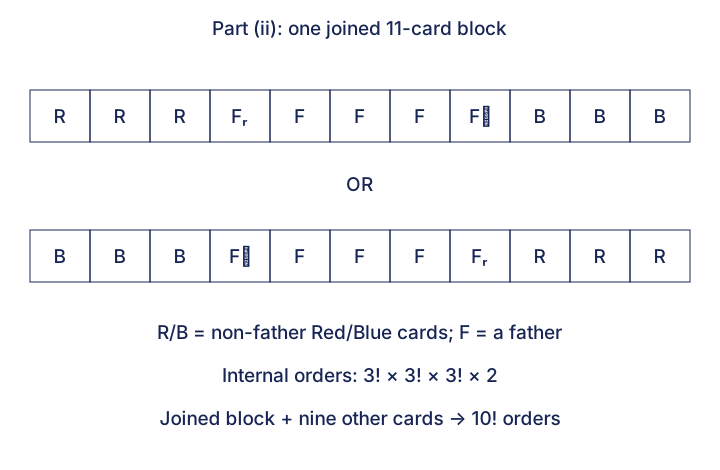
The father block overlaps the Red family at Father Red and the Blue family at Father Blue. To keep all three groups consecutive, Father Red and Father Blue must occupy opposite ends of the five-father block. The other three Red cards attach outside Father Red and the other three Blue cards outside Father Blue. The source’s two diagram rows show precisely these two orientations. The resulting 11-card construction is one joined block, not three independent blocks.
(ii) Arrange inside and outside the joined block
The three non-father Red cards have orders, the three non-father Blue cards have , and the three middle fathers (Green, Yellow, Orange) have . The ends Father Red and Father Blue can be assigned in 2 ways. The joined block and the 9 other non-father cards make 10 distinguishable objects. Hence .
Compare your sketch
Expand diagramFit diagram to page
Use the scrollbars or arrow keys to inspect details.
Common mistakes
Treating the Red family, Blue family and fathers as disjoint objects would count shared cards more than once.
Solution notes
All asks, printed marks 2 and 3, complete factor interpretations and both source diagram orientations retained. The 11-card joined block is made explicit to explain why the external arrangement factor is 10!, not a count of three independent blocks.