Worked solution
Count a shared middle pearl once
A string has 31 pearls, with the largest and most expensive in the middle. From one end each pearl is worth $100 more than its predecessor up to the middle; from the other end each is worth $150 more. The whole string costs $63,000. Find the middle pearl’s value.
[2007/SAJC/I/9(a)]
CJC · Discussion · Question 5
Answer
The middle pearl costs $3000.
Express the two inclusive half-string sums
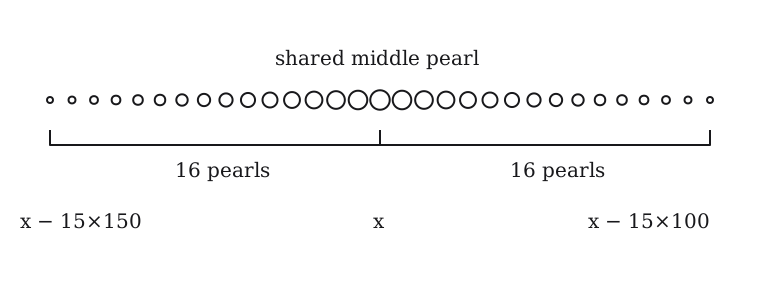
Let the middle pearl cost dollars. Each end-to-middle half contains pearls and price increases. The endpoints are and . The two sums are and .
How did this part go?
Remove the duplicated middle pearl
The combined inclusive halves count the middle pearl twice, so . This gives , hence .
How did this part go?
Compare your sketch
Expand diagramFit diagram to page
Use the scrollbars or arrow keys to inspect details.
Common mistakes
Subtract the shared middle value once when adding the two halves.