Porisma

Worked solution

Bound the tail of a convergent geometric series

The series 1+e−x+e−2x+⋯1+e^{-x}+e^{-2x}+\cdots has a sum to infinity. Show that x>0x>0. When x=10x=10, write SnS_n and SS, the finite and infinite sums. Show that S−Sn<S/10100S-S_n<S/10^{100} requires n>10ln⁡10n>10\ln10.

CJC · Discussion · Question 7

Answer

x>0x>0; Sn=(1−e−10n)/(1−e−10)S_n=(1-e^{-10n})/(1-e^{-10}), S=1/(1−e−10)S=1/(1-e^{-10}); n>10ln⁡10n>10\ln10.

Apply the convergence condition

The ratio is r=e−x>0r=e^{-x}>0. A finite sum to infinity requires ∣r∣<1|r|<1, equivalent to x>0x>0. The graph of e−xe^{-x} lies between −1-1 and 11 precisely for x>0x>0.

How did this part go?

Write the two sums for x = 10

Sn=(1−e−10n)/(1−e−10)S_n=(1-e^{-10n})/(1-e^{-10}) and S=1/(1−e−10)S=1/(1-e^{-10}).

How did this part go?

Compare the tail to the stated fraction

S−Sn=e−10n/(1−e−10)=Se−10nS-S_n=e^{-10n}/(1-e^{-10})=Se^{-10n}. The inequality is equivalent to e−10n<10−100e^{-10n}<10^{-100}, hence 10n>100ln⁡1010n>100\ln10 and n>10ln⁡10n>10\ln10. In integer terms the least possible nn is 2424.

How did this part go?

Compare your sketch

Expand diagram

Use the scrollbars or arrow keys to inspect details.
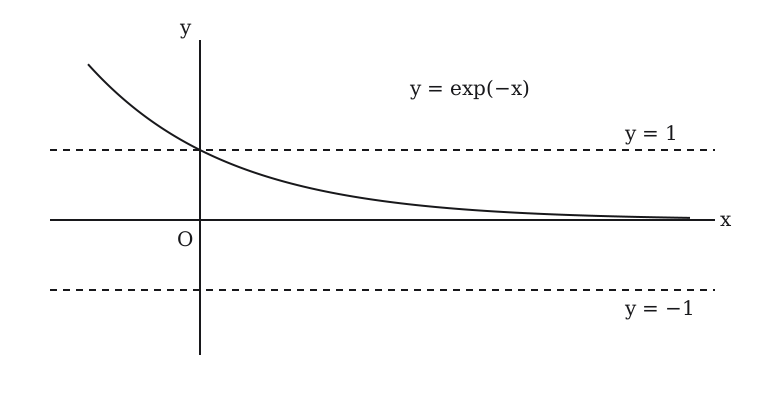
Decreasing exponential y=exp(−x), crossing y=1 at x=0. Dashed horizontal lines y=1 and y=−1 show that the curve lies strictly between them for x>0.

Common mistakes

Keep the strict inequality when converting the logarithmic bound to an integer.

Read the hint