Worked solution
Find a positive fixed point and prove decrease above it
Positive real terms satisfy .
(i) If the sequence converges, show its limit is .
(ii) Prove whenever .
[2010/TJC/JC2/MYE/1]
CJC · Discussion · Question 14
Answer
Conditional limit ; terms above it decrease at the next step.
(i) Solve the nonnegative fixed-point equation
If , continuity gives , with . Squaring yields , so ; the negative root is inadmissible. Hence .
How did this part go?
(ii) Compare the next term with the current one
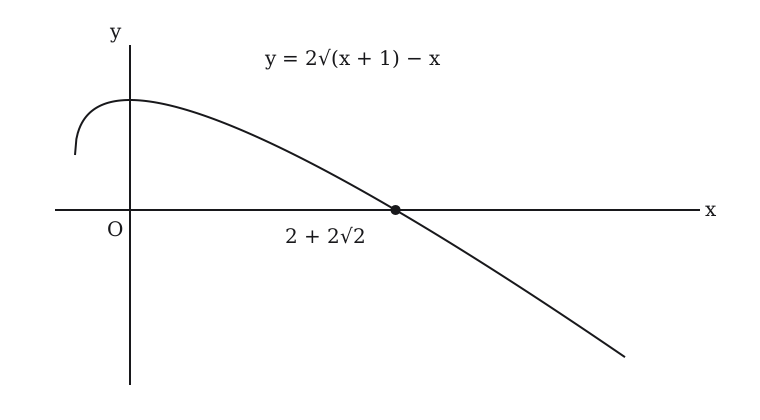
Let and . For , , so . Both sides to be compared are positive, hence . With , this gives . The source sign graph of shows the same negative region beyond .
How did this part go?
Compare your sketch
Expand diagramFit diagram to page
Use the scrollbars or arrow keys to inspect details.
Common mistakes
A fixed-point calculation identifies a possible limit; it does not alone prove convergence.