Porisma

Worked solution

Rational inequalities with transformed inputs

It is given that f(x)=x−52x−3f(x)=\dfrac{x-5}{2x-3}. Using an algebraic method, solve the inequality f(x)≤23f(x)\leq\dfrac23.

Hence find the exact range of values of xx for which

(i) f(ln⁡x)≤23f(\ln x)\leq\dfrac23,

(ii) f(∣x+12∣)≤23f\left(\left|x+\dfrac12\right|\right)\leq\dfrac23.

[2013/RI/I/10]

CJC · Discussion · Question 4

Answer

x≤−9x\leq-9 or x>3/2x>3/2. (i) 0<x≤e−90<x\leq e^{-9} or x>e3/2x>e^{3/2}. (ii) x<−2x<-2 or x>1x>1.

Algebraic solution

x−52x−3−23≤0\dfrac{x-5}{2x-3}-\dfrac23\leq0 gives 3(x−5)−2(2x−3)3(2x−3)≤0\dfrac{3(x-5)-2(2x-3)}{3(2x-3)}\leq0, hence x+92x−3≥0\dfrac{x+9}{2x-3}\geq0. The sign is positive, negative, positive across −9-9 and 3/23/2. Include the numerator zero and exclude the pole: x≤−9x\leq-9 or x>3/2x>3/2.

How did this part go?

(i)

ln⁡x≤−9\ln x\leq-9 or ln⁡x>3/2\ln x>3/2. Since x>0x>0 and exponentiation increases, 0<x≤e−90<x\leq e^{-9} or x>e3/2x>e^{3/2}.

How did this part go?

(ii)

∣x+1/2∣≤−9|x+1/2|\leq-9 has no solution. The other branch is ∣x+1/2∣>3/2|x+1/2|>3/2, giving x+1/2>3/2x+1/2>3/2 or x+1/2<−3/2x+1/2<-3/2. Thus x>1x>1 or x<−2x<-2.

How did this part go?

Compare your sketch

Expand diagram

Use the scrollbars or arrow keys to inspect details.
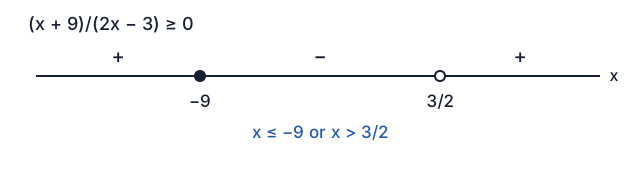
The expression (x+9)/(2x−3) has signs positive, negative, positive across −9 and 3/2. Include −9, exclude 3/2; the nonnegative set is x≤−9 or x>3/2.

Common mistakes

An absolute value cannot be negative; a logarithmic input requires x>0.

Solution notes

The solution diagrams are independently drawn from the printed mathematical relationships. Geometry is illustrative; use the labelled critical values and endpoint symbols.

Read the hint