Porisma

Worked solution

Find a range using the discriminant

It is given that y=x2+x+1x−1y=\dfrac{x^2+x+1}{x-1}, x∈Rx\in\mathbb R, x≠1x\ne1.

Without using a calculator, find the set of values that yy can take.

[2013/I/2]

CJC · Discussion · Question 5

Answer

(−∞,3−23]∪[3+23,∞)(-\infty,3-2\sqrt3]\cup[3+2\sqrt3,\infty).

Rearrange

xy−y=x2+x+1xy-y=x^2+x+1, so x2+(1−y)x+(1+y)=0x^2+(1-y)x+(1+y)=0.

How did this part go?

Real inputs

For real roots, b2−4ac≥0b^2-4ac\geq0: (1−y)2−4(1+y)≥0(1-y)^2-4(1+y)\geq0, giving y2−6y−3≥0y^2-6y-3\geq0. Its zeros are 6±36+122=3±23\dfrac{6\pm\sqrt{36+12}}2=3\pm2\sqrt3. The upward quadratic is nonnegative outside and at its two zeros. Thus y≤3−23y\leq3-2\sqrt3 or y≥3+23y\geq3+2\sqrt3.

How did this part go?

Compare your sketch

Expand diagram

Use the scrollbars or arrow keys to inspect details.
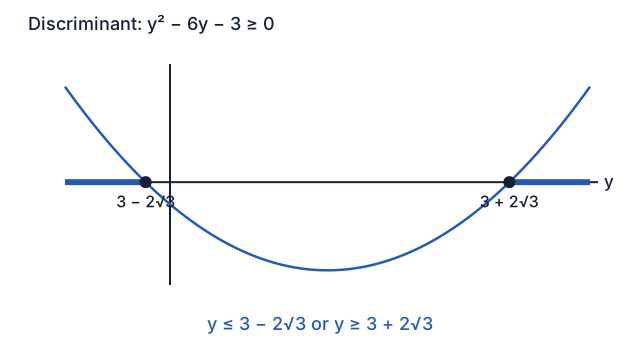
The upward parabola y²−6y−3 crosses the horizontal y-axis at 3−2√3 and 3+2√3. It is nonnegative at and outside these two roots, giving the two closed boundary rays for the range.

Common mistakes

Check the excluded input after rearranging: x=1 gives 3=0, so no discriminant-admitted root is invalid.

Solution notes

The solution diagrams are independently drawn from the printed mathematical relationships. Geometry is illustrative; use the labelled critical values and endpoint symbols.

Read the hint