Worked solution
Quadratics positive for every real input
(a) Show that if for all real , then .
(b) Find the range of values of for which is always positive for all real . Deduce the range of values of for which for all real .
CJC · Discussion · Question 6
Answer
(a) . (b) ; product positive for all real inputs when .
(a)
for all real . The leading coefficient is positive, so the discriminant must be negative: , or . Hence .
(b)
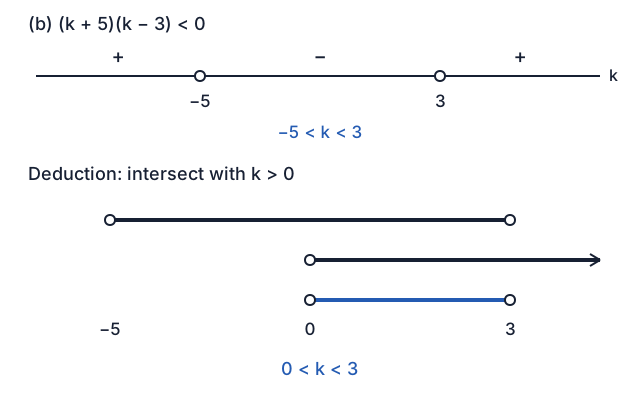
The discriminant condition is , hence . The sign chart is positive, negative, positive across and , giving .
Deduction
For the product to be positive, either the quadratic and k are both negative or both positive. The quadratic cannot be negative for every real x because its leading coefficient is positive. Thus require and . Their intersection is .
Compare your sketch
Expand diagramFit diagram to page
Use the scrollbars or arrow keys to inspect details.
Common mistakes
A zero discriminant allows a zero value, so it fails strict positivity.
Solution notes
The solution diagrams are independently drawn from the printed mathematical relationships. Geometry is illustrative; use the labelled critical values and endpoint symbols.